
Medical Council · NMBI · Dental Council · PSI · CORU · Complaint or fitness to practise inquiry
Dealing with a Complaint or Investigation Professionally for healthcare professionals facing a complaint, an employer investigation or a fitness to practise inquiry
A complaint has arrived. How you respond now is part of what will be judged.
- Complaint — a patient or family complaint about care, communication or attitude
- First reply — what to say in the first response, and what to leave out
- Employer — an employer investigation, a written statement or an interview
- Regulator — a complaint referred to your regulator, or a notice of inquiry
- Records — a gap in the notes, a late entry, or an email that reads badly
- Behaviour — attitude, tone, or a boundaries concern with a patient or a colleague, raised in the complaint
- Wellbeing — the strain of the process, and keeping practice safe meanwhile
- Any other complaint — or investigation about your practice or conduct
Facing a complaint, an employer investigation or a fitness to practise inquiry — before the Medical Council, NMBI, the Dental Council, the Pharmaceutical Society of Ireland or CORU?
This course is for a healthcare professional dealing with a complaint, an employer investigation or a fitness to practise inquiry. This course helps you remediate — and show the remediation, with a dated certificate for your written response, your reflection, an undertaking or an inquiry.
| Courses | Price per course | You save |
|---|---|---|
| 1 | €100 | No saving |
| 2 | €88 | €25 |
| 3 | €83 | €50 |
| 5 | €80 | €100 |
| 10 | €70 | €300 |
Add courses. The saving is applied in the basket.
Immediate access · certificate on completion · twelve months' access
- 2 CPD hours
- Self-paced
- Written for Ireland
- CPD certificate
- From €70 a course (Bulk Buy of 10)
 Dr Shehzad IqbalFounder, course author and facilitatorMBBS, MRCS, MRCGP
 Dr Mo MirzaCourse facilitatorMedically trained, UCL London
 Ludmila UpenieceBusiness development and supportPsychology, UEL London
At a glance
- Who it is for
- Any healthcare professional in Ireland dealing with a patient complaint, an employer investigation, a complaint to their regulator, a preliminary decision or a fitness to practise inquiry
- Regulator covered
- Applies to practitioners registered with the Medical Council, NMBI, the Dental Council, the Pharmaceutical Society of Ireland or CORU
- Length
- 10 sections, 93 lessons, 2 CPD hours
- Format
- Self-paced, online, immediate access, twelve months from purchase
- Certificate
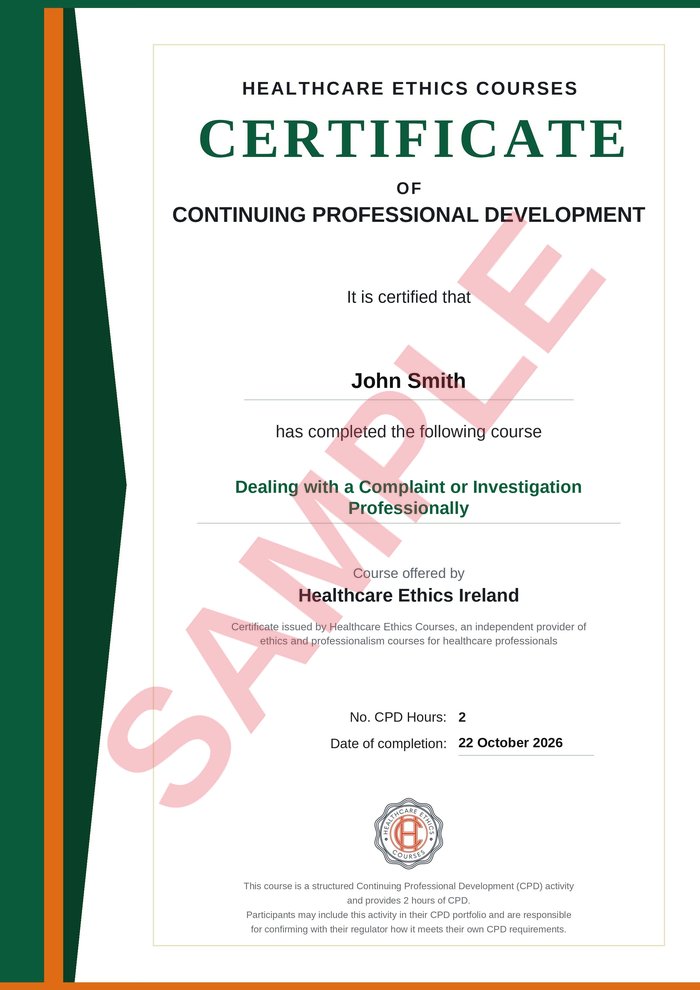
- Certificate issued by Healthcare Ethics Courses on completion, dated, with the course title and 2 CPD hours
- Price
- €100 · from €70 a course (Bulk Buy of 10)
Certificate issued by Healthcare Ethics CoursesRemediation courses for regulatory processes.
The certificate you will receive
How healthcare professionals use it
- With a written response to your regulator or its preliminary committee, alongside a reflection
- When an undertaking or a consent is discussed, or in your evidence to an inquiry committee
- As a dated record of remediation for the regulator when sanction is considered
Who this course is for
A complaint has just arrived
A patient or a family has complained, and you have to reply. Section 3 covers the first response: pausing before you write, acknowledging the complaint, tone and language, an apology that is not an admission of fault, and what to leave out.
Facing an employer investigation
An incident review, a disciplinary or capability process, a request for a written statement or an interview. Section 4 covers your responsibilities, how to prepare a statement that separates what you know, what you recall and what you infer, and how to handle an interview.
Facing a complaint to your regulator
The Medical Council, NMBI, the Dental Council, the PSI or CORU has written to tell you of a complaint. Your first written reply is where your conduct in the process is first read, and the course gives it a structure you can follow under pressure.
Before a Preliminary Proceedings Committee
At the Medical Council, NMBI, the PSI and CORU the committee looks at a complaint before any inquiry, with your written response in front of it. Section 5 covers how a regulatory investigation works and how your conduct during it is read.
Facing a fitness to practise inquiry
The complaint has gone to a Fitness to Practise Committee, a Professional Conduct Committee or a Health Committee. Remediation completed before the hearing, dated and documented, is evidence you can put before the committee and the regulator.
Struggling with the strain
Anxiety, lost sleep, doubt about your own judgement. Section 9 covers the emotional impact of a complaint, the early signs of distress, where to find support and advice, and keeping practice safe while the matter is open.
The concerns this course speaks to
Why complaints arise
Feeling rushed or dismissed, a poor explanation, a delay without an update, a mismatch between expectation and outcome. Section 2 covers why complaints arise even where care was clinically appropriate, and why a pattern of smaller concerns attracts a regulator’s attention.
The first response
A defensive or delayed reply can turn a local complaint into an investigation. Section 3 covers acknowledgement, tone, apologies and explanations, sticking to the facts in the record, and what not to include — with every reply written as if a regulator will read it.
Statements and interviews
A written statement that will be read by an employer and possibly a regulator; an interview with questions you did not expect. Section 4 covers chronology, honesty about what you do not remember, and calm, accurate answers.
Records, emails and messages
A late entry, a gap in the notes, an email written in frustration. Section 6 covers clinical records as primary evidence, late entries marked as late, original entries never deleted, and consistency between what you wrote then and what you say now.
Professional boundaries with a patient or a colleague
A complaint about a boundary with a patient or a colleague is one the course lists among the concerns that can take a matter to regulatory level (Section 5).
Insight without self-blame
Accepting that a concern is legitimate, even if you dispute parts of it, without blaming yourself for what was outside your control or blaming others for what was not. Section 7 covers insight, attitude and the behaviours that escalate or reduce concern.
Reflection and remediation
Reflection that analyses rather than restates; remediation that is targeted, proportionate and started early. Section 8 covers the pitfalls in a reflective response, the types of remediation and the evidence that shows it.
Wellbeing and advice
The process is hard, and it does not pause patient care. Section 9 covers seeking support as a professional strength, professional advice and representation, and keeping practice safe while the investigation continues.
Facing a complaint to your regulator or a fitness to practise inquiry? This course helps you remediate — and show it.
Buy this course — €100 (€70 with Bulk Buy 10)What the course covers
Ten sections and 93 lessons, with a reflective quiz closing each of the first nine and a post-course assessment at the end.
Introduction to Complaints and Investigations in Healthcare
Six lessons
Why Complaints Arise
Nine lessons
Responding to a Complaint Professionally
Ten lessons
Employer and Organisational Investigations
Eleven lessons
Regulatory Investigations and Fitness to Practise
Twelve lessons
Communication, Documentation, and Evidence
Eleven lessons
Insight, Attitude, and Professional Behaviour
Ten lessons
Reflection and Remediation After Complaints
Eleven lessons
Protecting Wellbeing and Professional Resilience
Eleven lessons
Conclusion and Key Takeaways
Two lessons, Conclusion and Key Takeaways, and the post-course assessment
Show every lesson title
- Section 01 · Introduction to Complaints and Investigations in Healthcare
- Why Complaints and Investigations Are Part of Modern Healthcare; Complaints Versus Investigations: Understanding the Difference; The Professional Impact of Complaints and Investigations; Why the Response Can Matter More Than the Allegation; Regulatory Context in Ireland; The Purpose of This Course.
- Section 02 · Why Complaints Arise
- Complaints About Experience, Not Clinical Skill; Communication Failures and Misunderstandings; Expectations, Outcomes, and Disappointment; Delays, Access Issues, and System Pressures; Documentation and Information Gaps; Behaviour, Attitude, and Professionalism; Complaints Following Adverse Events or Errors; Repeated Low-Level Concerns and Pattern Formation; Regulatory Perspective on Why Complaints Arise.
- Section 03 · Responding to a Complaint Professionally
- The Importance of the Initial Response; Pausing Before Responding; Acknowledging the Complaint; Tone, Language, and Professionalism; Apologies and Explanations; Providing Clear and Honest Explanations; Sticking to the Facts; Knowing What Not to Include; Escalation Awareness; Learning Orientation in the Response.
- Section 04 · Employer and Organisational Investigations
- What Employer and Organisational Investigations Are; The Purpose of Employer Investigations; Types of Employer Investigations; Your Professional Responsibilities During an Investigation; Preparing Written Statements and Accounts; Interviews, Meetings, and Formal Hearings; Documentation, Records, and Evidence; Behaviour, Attitude, and Insight; Interim Measures and Risk Controls; Interaction With Professional Regulators; A Learning-Focused Approach.
- Section 05 · Regulatory Investigations and Fitness to Practise
- Understanding Regulatory Investigations in Ireland; What “Fitness to Practise” Really Means; How Complaints Escalate to Regulatory Level; The Irish Regulatory Landscape; How Regulators Assess Cases: A Holistic Approach; The Central Importance of Insight; Professional Conduct During Regulatory Investigations; Interim Measures and Conditions on Practice; Possible Outcomes of Regulatory Investigations; Demonstrating Safe Future Practice; Interaction Between Employer and Regulatory Processes; Emotional and Professional Impact of Regulatory Processes.
- Section 06 · Communication, Documentation, and Evidence
- Why Communication and Documentation Are Critical in Complaints and Investigations; Written Communication: Complaints Responses and Statements; Chronology and Clarity; Clinical Records as Primary Evidence; Documentation of Judgement and Decision-Making; Retrospective Documentation: Risks and Warning Signs; Emails, Messages, and Informal Communication; Consistency Across Evidence Sources; Documentation and Regulatory Expectations; Evidence Beyond Records; Using Communication to De-escalate Concerns.
- Section 07 · Insight, Attitude, and Professional Behaviour
- How Insight and Attitude Affect Outcomes; What Regulators Mean by “Insight”; The Difference Between Insight and Blame; Attitude During Complaints and Investigations; Behaviour That Escalates Risk; Behaviour That Mitigates Risk; Consistency and Credibility; Insight Across Different Professional Contexts; Demonstrating Learning, Not Just Regret; Professional Identity and Humility.
- Section 08 · Reflection and Remediation After Complaints
- Why Reflection and Remediation Are Central After a Complaint; Reflection: Moving Beyond Description to Analysis; Demonstrating Insight Through Reflection; Common Pitfalls in Reflective Responses; What Remediation Means in Practice; Types of Remediation After Complaints; Evidence of Remediation: What Regulators Look For; Timing and Proactivity in Remediation; Remediation and Return to Safe Practice; Rebuilding Trust After a Complaint; Reflection and Remediation as Ongoing Skills.
- Section 09 · Protecting Wellbeing and Professional Resilience
- The Emotional Impact of Complaints and Investigations; Why Wellbeing Matters for Patient Safety; Recognising Early Signs of Distress; Seeking Support: A Professional Strength; Professional Advice and Representation; Maintaining Safe Practice During Investigations; Managing Stigma and Isolation; Resilience: What It Is and What It Is Not; Organisational and Regulatory Expectations; Rebuilding Confidence After a Complaint; Long-Term Professional Resilience.
- Section 10 · Conclusion and Key Takeaways
- Conclusion; Key Takeaways.
How to respond to a complaint or investigation professionally
Whether the reader is a patient, an employer, a preliminary committee or an inquiry committee, a response is read for professionalism as well as facts. These are the four parts to set out, and what the course gives you for each.
The first reply to a complaint is read by the patient today, and may be read by your regulator later.
- AcknowledgementThat the complaint was received, and the effect on the person who made it.Section 3 covers pausing before you respond, and an acknowledgement that is not an admission of fault.
- The facts, in orderA clear chronology that matches the clinical record.Sections 3 and 6 cover sticking to the facts, chronology and consistency with the record.
- Apology and explanationAn apology for the distress, and a plain account of the reasoning.Section 3 covers apologies that are not conditional and explanations that answer each concern.
- LearningWhat you have reflected on and what has changed.Section 8 covers reflection and remediation after a complaint — and this course is a dated item for your response.
A reply written to win the argument is read as a sign that the risk remains.
Take advice from your indemnifier, your union or professional body, or a solicitor before you respond to anyone.
Facing a complaint to your regulator or a fitness to practise inquiry? This course helps you remediate — and show it.
Buy this course — €100 (€70 with Bulk Buy 10)How this course helps with a complaint or fitness to practise inquiry
Local, employer and regulatory processes
A complaint may be resolved locally, investigated by an employer or referred to a regulator. NMBI says “Some concerns may be more appropriately addressed at a local level.” (NMBI); in 2024, 45% of the complaints NMBI received came from employers (State of Complaints 2024). CORU says employers should tell it when a registrant has been dismissed or there is a case of serious misconduct (CORU). The course covers each process in turn (Sections 3, 4 and 5) and how what you write in one is read in the next.
Time, records and advice
None of the five regulators publishes a fixed deadline for a first reply; NMBI says “you may request an extension of time to respond to a complaint” (NMBI) and advises registrants to “contact your representative body and / or obtain legal advice”. The course covers records as evidence (Section 6), insight and attitude (Section 7), and wellbeing and advice (Section 9). For the stages from the first letter to the High Court, see the fitness to practise process in Ireland, explained.
Read the primary sources
- Guidance on Sanctions Imposed by the Medical Council (28 May 2024)
- Undertakings and Consents Guidance — Medical Council
- Guidance on Sanctions — Nursing and Midwifery Board of Ireland
- Fitness to practice — Dental Council of Ireland
- Disciplinary committees — Pharmaceutical Society of Ireland
- What happens when CORU receives a complaint
- CORU fitness to practise trends report (2022 to 2024)
Who wrote it

Dr Shehzad Iqbal
Course author and facilitator, Healthcare Ethics Ireland
Dr Iqbal wrote this course. He combines clinical practice with a formal postgraduate qualification in healthcare law and ethics, and has worked with registrants across the regulated health professions, online and face to face, since 2020.
He founded Probity & Ethics in the United Kingdom in 2020 and Healthcare Ethics Courses, which issues the certificates, in 2025. More about us.
MBBS · MRCS · MRCGP · Postgraduate Certificate in Healthcare Law and Ethics, University of Dundee
Written and reviewed by Dr Shehzad Iqbal. Last reviewed .
In short
Dealing with a Complaint or Investigation Professionally is a two-hour, self-paced remediation course for healthcare professionals in Ireland — registered with the Medical Council, NMBI, the Dental Council, the Pharmaceutical Society of Ireland or CORU — who face a patient complaint, an employer investigation, a complaint to their regulator or a fitness to practise inquiry. It separates a complaint from an investigation; covers why complaints arise; the first response — acknowledgement, tone, apology and explanation, facts and what to leave out; employer and organisational investigations, statements and interviews; regulatory investigations and fitness to practise; communication, records and evidence; insight, attitude and professional behaviour; reflection and remediation after a complaint; and protecting your wellbeing and keeping practice safe. Ten sections, the first nine closing with a reflective quiz, a post-course assessment, and a dated certificate from Healthcare Ethics Courses. It is remediation and dated evidence of it; it decides no complaint, and it is not a substitute for advice from your indemnifier, your union or professional body, or a solicitor.
A complaint, an employer investigation and a regulatory investigation
A complaint and an investigation are different processes, and one can lead to the other. A complaint can be raised by a patient, a family, a colleague or an employer, and may be handled locally by an employer or a service. An investigation is a formal review: internal, by an employer, or external, by a regulator, and it looks at standards, risk and fitness to practise. The course explains how a complaint escalates — seriousness or repetition, a defensive or inadequate response, a risk to patient safety, a lack of insight or cooperation.
Each process reads what came before it. An employer’s report and the statements given to it may be shared with a regulator, so the course treats consistency, honesty and professionalism across all of them as one task.
Write every reply, statement and email as if your regulator will read it, because it may.
What these words mean
The three terms that decide where a complaint goes, and the words the course is built on.
- Preliminary Proceedings Committee
- The committee of the Medical Council, NMBI, the PSI and CORU that looks at a complaint before any inquiry: it may take no further action, suggest mediation, conclude the matter with an undertaking or a consent where its Act allows, or refer the complaint to an inquiry. At the Dental Council the Fitness to Practise Committee considers whether there is a prima facie case.
- Fitness to practise inquiry
- The hearing stage: before the Fitness to Practise Committee at the Medical Council, NMBI and the Dental Council, and before the Professional Conduct Committee or the Health Committee at the PSI and CORU. Any sanction heavier than an advice, admonishment or censure takes effect only when the High Court confirms it.
- Professional misconduct
- A ground of complaint under four of the Acts and, under the Dentists Act 1985, a ground for an application for an inquiry. The Dental Council describes it as a serious falling short in the standards expected of a dentist; the PSI as behaviour that goes against its Code of Conduct for registered pharmacists; CORU as any act, omission or pattern of conduct that breaches the Code.
Complaints, investigations and the other terms the course uses
- Complaint
- A concern raised by a patient, a family, a colleague, an employer or the regulator itself. Not a finding: the start of a process.
- Employer investigation
- A formal internal review — a local complaint review, an incident investigation, a governance review, a disciplinary or capability process — that may lead to an action plan, supervision, restrictions, disciplinary action or referral to a regulator.
- Interim measures
- Steps an employer or a regulator takes to manage risk while a matter is open, such as supervision or a restriction of duties. The course treats engaging with them as part of professionalism.
- Written statement
- An account prepared for an investigation, in chronological order, that separates what you know, what you recall and what you infer.
- Late entry
- An addition to a record made after the event, clearly marked as late, without altering the original entry.
- Insight
- Understanding why a concern arose and its effect on patients, colleagues and trust, without blaming others or yourself unfairly.
- Remediation
- Targeted, proportionate and sustained steps to address a concern, with evidence that they were taken.
The Acts a complaint is made and decided under
Ireland’s five health regulators each work under their own Act, all five amended by the Regulated Professions (Health and Social Care) (Amendment) Act 2020. These are the sections that say who may complain, on what grounds, and who looks at the complaint first.
Medical Council — Medical Practitioners Act 2007, section 57
A person, including the Council, may complain to the chief executive officer. The grounds include professional misconduct, poor professional performance, a relevant medical disability, and a failure to comply with a condition, an undertaking or a consent. The chief executive officer looks at the complaint first, an Authorised Officer may gather the facts, and the Preliminary Proceedings Committee decides whether there is enough cause to take further action. Read it.
For this course: Section 5 covers regulatory investigations, and Section 3 a first response written knowing the Council may read it later.
NMBI — Nurses and Midwives Act 2011, section 55
A person, including the Board, may complain to the chief executive officer. The grounds include professional misconduct, poor professional performance, non-compliance with a code of professional conduct, a relevant medical disability, and an irregularity in relation to the custody, prescription or supply of a controlled drug. A Preliminary Proceedings Committee, assisted by a case officer, may refer a complaint to the Fitness to Practise Committee for a sworn oral inquiry. Read it.
For this course: Sections 3 and 4 cover the response to a complaint and an employer investigation; NMBI says some concerns may be addressed at a local level.
Dental Council — Dentists Act 1985, section 38
The Council or any person may apply to the Fitness to Practise Committee for an inquiry, on grounds that include alleged professional misconduct and alleged unfitness to practise by reason of physical or mental disability. This is an application for an inquiry rather than a complaint: the Fitness to Practise Committee considers whether there is a prima facie case, and if there is, it holds the inquiry. Read it.
For this course: Section 5 covers regulatory investigations and fitness to practise in general terms, and Section 6 the records an inquiry will read.
Pharmaceutical Society of Ireland — Pharmacy Act 2007, section 35
A complaint may be made in writing by or on behalf of any person, or by the registrar. The grounds include professional misconduct, poor professional performance, the effect on practice of a physical or mental ailment, emotional disturbance, or alcohol or drug addiction, and a failure to comply with a condition or an undertaking. The PSI separates a concern from a statutory complaint, which is for issues of a serious nature; its Preliminary Proceedings Committee may refer a complaint to a committee of inquiry or to mediation. Read it.
For this course: The PSI separates a concern from a statutory complaint; Section 3 covers the first response to either.
CORU — Health and Social Care Professionals Act 2005, section 52
A complaint may be made to the Council by or on behalf of any person, or by a registration board. The grounds include professional misconduct, which CORU describes as any act, omission or pattern of conduct that breaches the Code, and poor professional performance. The Preliminary Proceedings Committee screens out complaints that are trivial, vexatious, without substance or made in bad faith; the Professional Conduct Committee deals with conduct or competence, and the Health Committee with whether a registrant’s health is affecting their ability to practise. Read it.
For this course: Section 4 covers employer investigations; CORU expects employers to complain where a registrant is dismissed or there is serious misconduct.
Also engaged: Sanctions — advice, admonishment or censure, conditions, suspension and cancellation (erasure under the Dentists Act): Medical Practitioners Act s.71, Nurses and Midwives Act s.69, Dentists Act ss.39 to 41, Pharmacy Act s.48, Health and Social Care Professionals Act s.66 · High Court confirmation — the heavier sanctions take effect only when the High Court confirms them; an advice, admonishment or censure on confirmation or once the appeal window of 21 or 30 days passes without an appeal · The 2020 Act — the Regulated Professions (Health and Social Care) (Amendment) Act 2020, which amended all five Acts in stages from 2021 to 2025.
What happens after a complaint reaches an Irish regulator
Each regulator has its own Act and its own names for the stages, and your letter tells you which stage you are at. At each of them the same three things are worth showing in writing: that you see what went wrong, that you understand it against your regulator’s code, and what you have changed, with dated evidence.
The complaint and the grounds
Anyone may complain, including the regulator itself. Under the Medical Practitioners Act and the Nurses and Midwives Act the complaint goes to the chief executive officer; under the Pharmacy Act it may be made by or on behalf of any person or by the registrar; under the Health and Social Care Professionals Act by or on behalf of any person or by a registration board. Under the Dentists Act the Council or any person applies to the Fitness to Practise Committee for an inquiry. Professional misconduct is a ground of complaint under the four other Acts and, under the Dentists Act 1985, a ground for an application for an inquiry.
The preliminary stage
The Medical Council, NMBI, the PSI and CORU each have a Preliminary Proceedings Committee. At the Medical Council the chief executive officer looks at a complaint first and may assign an Authorised Officer, and the committee decides whether there is enough cause to take further action. At NMBI the committee may refer a complaint to the Fitness to Practise Committee for a sworn oral inquiry, or suggest mediation or informal resolution; at the PSI it may refer a complaint to a committee of inquiry or to mediation; at CORU it screens out complaints that are trivial, vexatious, without substance or made in bad faith. At the Dental Council the Fitness to Practise Committee considers whether there is a prima facie case.
Undertakings, consents and mediation
A complaint can be concluded by agreement in some cases. At the Medical Council’s preliminary stage a doctor may be asked to undertake not to repeat the conduct, or to consent to censure (2025 procedures). At NMBI in 2024, 12 undertakings or consents concluded matters at the preliminary stage and the Fitness to Practise Committee recommended 32 (State of Complaints 2024). Undertakings were the largest single Committee of Inquiry outcome in the cases CORU concluded in 2022 to 2024: 13, against 7 censures (trends report). In 2024 the Dental Council accepted undertakings from a dentist instead of making a High Court application (Annual Report 2024). Mediation at NMBI and CORU needs the consent of both sides.
The inquiry
The inquiry committee is the Fitness to Practise Committee at the Medical Council, NMBI and the Dental Council, and the Professional Conduct Committee or the Health Committee at the PSI and CORU. At NMBI allegations against a nurse or midwife must be proven beyond reasonable doubt. Medical Council inquiries are held in public unless the Council decides on a hearing in private or part private (Medical Council); CORU says its Professional Conduct Committee hearings are normally held in public and its Health Committee hearings normally in private.
The sanction and the High Court
Sanctions run from advice, admonishment or censure (admonishment or censure at the PSI and CORU) through conditions and suspension to cancellation, called erasure under the Dentists Act (MPA s.71, NMA s.69, Dentists Act s.39, Pharmacy Act s.48, HSCP Act s.66). The heavier sanctions take effect only when the High Court confirms them; an advice, admonishment or censure takes effect on confirmation or once the appeal window passes without an appeal: 21 days for doctors, nurses, midwives and dentists, 30 days for pharmacists and CORU registrants (MPA s.74, NMA s.72, Dentists Act s.41, Pharmacy Act s.50, HSCP Act s.68).
Interim measures and your first reply
Separately, the Medical Council says interim suspension is possible under section 60 of the Medical Practitioners Act 2007; where there is a serious and immediate risk, the PSI’s Council can seek suspension from the High Court; and the Dental Council may apply to the High Court for suspension under section 44 of the Dentists Act. None of the five regulators publishes a fixed deadline for a first reply: the Medical Council gives not less than two weeks to respond to an Investigation Report, and NMBI says you may request an extension of time. Take advice before you reply.
Facing a complaint to your regulator or a fitness to practise inquiry? This course helps you remediate — and show it.
Buy this course — €100 (€70 with Bulk Buy 10)Courses with the Ethics and Professionalism pair written to your own regulator’s code — for doctors, nurses and midwives, dentists, pharmacists and all other healthcare professionals, or every course →
Frequently asked questions
A complaint has just arrived. What should I do first?
Pause, read it fully and take advice before you reply. The course recommends separating the emotional reaction from the professional response, reviewing the records before you write, acknowledging the complaint, and never altering a record. None of the five regulators publishes a fixed deadline for a first reply; check any date in the letter.
Is an apology an admission of fault?
The course treats an apology for the patient’s distress or experience as appropriate and not an admission of negligence. Avoid a conditional or defensive apology, explain what happened in clear, honest terms, and acknowledge any shortcomings where appropriate. Ask your adviser how to word an apology in your own case.
My employer is investigating. Will the regulator see it?
It may. Employer investigation reports and the statements given to them may be shared with a regulator, and behaviour at employer level can influence how a regulator sees a case. The course covers your responsibilities in an employer investigation, written statements and interviews (Section 4), and consistency across processes (Section 5).
How do I write a statement for an investigation?
Review the records first, keep to the facts in chronological order, separate what you know from what you recall and what you infer, acknowledge uncertainty honestly, and avoid speculation, blame or emotive language. Do not rush it, and have your adviser read it before it is sent.
Can I add to the notes now that a complaint has been made?
Do not alter or delete an existing entry. If a late entry is needed, mark it clearly as late, with the date and the reason, and leave the original as it is. An undisclosed change made after a complaint turns a clinical question into one of honesty. Section 6 covers records as evidence.
The complaint is affecting my health. What should I do?
Seek support early: a trusted colleague or mentor, your manager or supervisor, occupational health, a professional support service, or counselling. The course treats seeking help as a professional strength and covers keeping practice safe while the matter is open (Section 9). If your health is affecting your practice, tell your adviser.
Should I take advice before I respond?
Yes — before anything is written to the regulator, a committee or your employer. If you work for a public health agency, note that the Clinical Indemnity Scheme says it does not provide representation at disciplinary proceedings or before professional regulatory bodies. Whatever your profession, ask your indemnifier, your union or professional body, or a solicitor. Nothing on this page is legal advice.
How long does it take, and how long do I have access?
The course is 2 CPD hours, self-paced, with access for twelve months from purchase. The certificate is issued on completion, dated, with the course title and the CPD hours. Whether the hours count towards your own CPD requirement is for your regulator or scheme to say: doctors must undertake a minimum of 50 hours in each scheme year, and CORU registrants must achieve 30 CPD credits in every 12-month period.
Can I get a certificate with a later date?
No. The certificate records the date you completed the course, and that date does not change. If your regulator, an inquiry committee or an employer asks for recent evidence, you buy the course again: half price within twelve months of your original purchase, the full €100 after that.
Will anyone be told that I am taking the course?
No. Nobody is told you are enrolled. We do not share participant details with any regulator, an employer, a union or an indemnifier; the certificate reaches them only if you attach it to your own response.
Courses that work alongside this one
A complaint asks for a professional response, and then for insight and remediation. These are the courses that pair with this one.
Fitness to Practise for Healthcare Professionals
What fitness to practise means to the five regulators, the concerns behind a case, weak and strong responses, and professionalism at a hearing.
Insight for Fitness to Practise
What insight is, how the five regulators frame it, weak and strong demonstrations of insight, and how insight is shown in a portfolio and at a hearing.
Reflection for Fitness to Practise
Weak and strong reflective statements, the Gibbs, Rolfe and Johns models, reflection against apology and justification, and the reflective portfolio.
Remediation for Fitness to Practise
What a regulator looks for in remediation, what a remediation portfolio contains, case studies across five professions, and remediation at a hearing.
Documentation for Healthcare Professionals
Good clinical documentation, consent and capacity, handover records, digital records and data protection, and records during a complaint.
Effective Communication for Healthcare Professionals
Communication with patients and families, difficult and high-risk conversations, handover and escalation, and written and digital communication.
Duty of Candour for Healthcare Professionals
When the duty applies, talking with patients and families after an adverse event, and candour during complaints and reviews.
Dealing with a Complaint or Investigation Professionally
This course. The first response to a complaint, employer and regulatory investigations, records and evidence, and your wellbeing.
Start today, finish at your own pace
Immediate access on purchase. Twelve months' access, a dated certificate on completion, and 2 CPD hours issued by Healthcare Ethics Courses.