
Medical Council complaint · Written to the Guide to Professional Conduct and Ethics
Ethics and Ethical Standards for Doctors for Doctors facing a Medical Council complaint or fitness to practise inquiry
The complaint concerns your ethical judgement, behaviour or conduct as a doctor.
- Boundaries — a boundaries breach with a patient or a colleague, or a dual relationship
- Dishonesty — a falsified document, an altered note, a false claim, or misleading the Council
- Consent — treatment without valid consent, risks not explained, or a refusal overridden
- Confidentiality — patient information accessed or shared without authority
- Records — notes missing, changed after the event, or not what happened
- Fees and interests — a claim for work not done, or a conflict of interest not declared
- Online conduct — a post, a message or a video consultation that did not meet the standard
- Any other — ethical concern or allegation of unethical conduct
Facing an allegation of unethical behaviour or professional misconduct like these — from the Medical Council, its Preliminary Proceedings Committee or the Fitness to Practise Committee?
This course is for a doctor facing a Medical Council complaint or fitness to practise inquiry. This course helps you remediate — and show the remediation, with a dated certificate for your written response, your reflection, an undertaking or an inquiry.
| Courses | Price per course | You save |
|---|---|---|
| 1 | €100 | No saving |
| 2 | €88 | €25 |
| 3 | €83 | €50 |
| 5 | €80 | €100 |
| 10 | €70 | €300 |
Add courses. The saving is applied in the basket.
Immediate access · certificate on completion · twelve months' access
- 2 CPD hours
- Self-paced
- Written for Ireland
- CPD certificate
- From €70 a course (Bulk Buy of 10)
 Dr Shehzad IqbalFounder, course author and facilitatorMBBS, MRCS, MRCGP
 Dr Mo MirzaCourse facilitatorMedically trained, UCL London
 Ludmila UpenieceBusiness development and supportPsychology, UEL London
At a glance
- Who it is for
- Any doctor facing a Medical Council complaint, a request from an Authorised Officer, a Preliminary Proceedings Committee decision or a fitness to practise inquiry about ethical judgement, behaviour or conduct — an allegation of unethical behaviour, conduct or action
- Regulator covered
- The Medical Council of Ireland, its Preliminary Proceedings Committee and its Fitness to Practise Committee, under the Medical Practitioners Act 2007
- Length
- 10 sections, 55 lessons, 2 CPD hours
- Format
- Self-paced, online, immediate access, twelve months from purchase
- Certificate
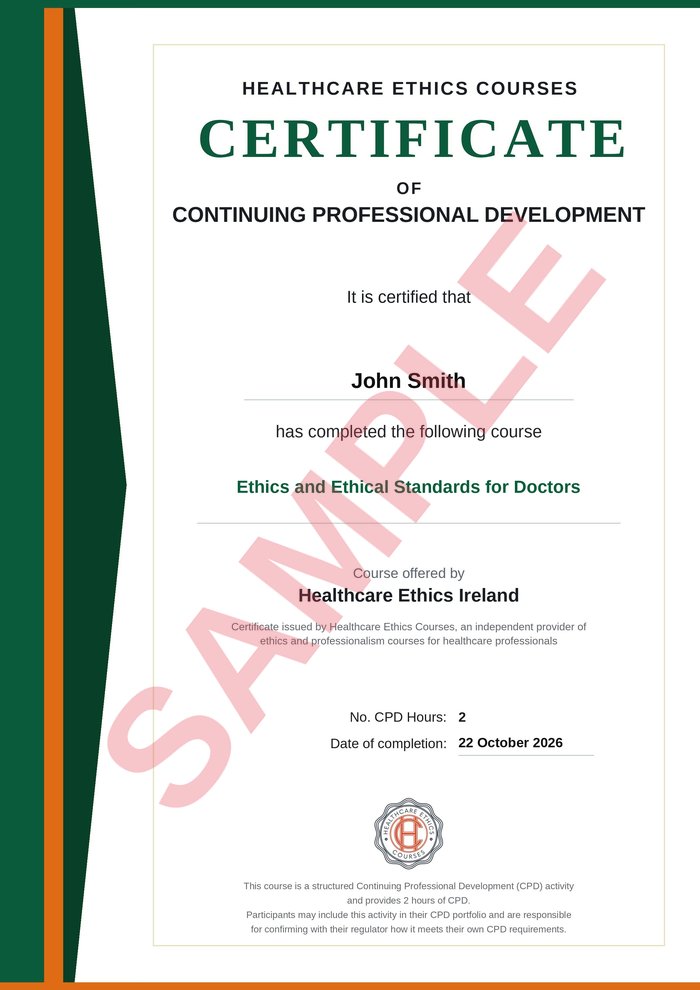
- Certificate issued by Healthcare Ethics Courses on completion, dated, with the course title and 2 CPD hours
- Price
- €100 · from €70 a course (Bulk Buy of 10)
Certificate issued by Healthcare Ethics CoursesRemediation courses for regulatory processes.
The certificate you will receive
How doctors use it
- With a written response to an Authorised Officer or the Preliminary Proceedings Committee, alongside a reflection
- When an undertaking is discussed, or in your evidence to the Fitness to Practise Committee
- As a dated record of remediation for the Council when sanction is considered
Who this course is for
Facing an allegation of unethical behaviour or professional misconduct
The letter says a decision, a disclosure, a relationship or a way of working did not meet the Guide to Professional Conduct and Ethics. This course is how you account for it — and show you have remediated.
Dealing with a Medical Council complaint
A patient, a relative, a colleague, an employer or the Council itself has complained, and the Council has written to tell you. Your written response is where your reasoning first appears; this course gives it a structure.
Asked to respond to an Authorised Officer
The chief executive officer has assigned an Authorised Officer, who may obtain your records and an expert opinion and asks for information within a period set in the notice. Dated remediation can be shown from this stage onwards.
Before the Preliminary Proceedings Committee
The committee decides whether there is enough cause to take further action, and may ask you for an undertaking or a consent. The Council’s undertakings guidance weighs the level of insight you have shown.
Facing a fitness to practise inquiry
The complaint has been referred to the Fitness to Practise Committee. Remediation completed before the hearing, dated and documented, is evidence you can put before the committee and the Council.
Under an undertaking, conditions or a sanction
An undertaking you have given, conditions attached to your registration or a sanction from the Council may ask you to show what you have done to address the concern. The certificate is dated and records 2 CPD hours in ethics.
The concerns this course speaks to
Professional and ethical boundaries
A friendship with a patient, messages outside the consultation, a relationship with a colleague that went beyond a working one, a dual relationship. Keeping the boundary is the doctor’s responsibility, with a patient or a colleague. Section 3 has a lesson on professional boundaries, and Section 7 compares a weak and a strong response to a friendship with a patient.
Probity and an allegation of dishonesty
A falsified document, a false claim, a certificate or declaration that is not true, the Council or an employer misled. Probity, honesty and accountability have a section of their own (Section 6), and Section 7 compares responses to documentation falsification and to billing misconduct.
Consent and a refusal of treatment
A procedure without valid informed consent, risks or alternatives not explained, a patient’s refusal overridden. The course covers respect for patient autonomy and consent (Section 3), informed refusal against beneficence (Section 4) and a consent failure as a case comparison (Section 7).
Confidentiality and privacy
Information accessed without a clinical reason, shared without authority or left unsecured; a disclosure made, or not made, to protect someone else. Section 5 covers the ethical duty of confidentiality and data protection law (GDPR), and Section 4 the conflict between confidentiality and a duty to report.
Records that do not say what happened
A note altered after the event, an entry added later without saying so, a consultation not documented. A record changed after you learn of a complaint, without saying so, raises a question of honesty as well as of care. The course covers honesty in documentation and communication, and the weak and strong response to a falsified record.
Fees, billing and conflicts of interest
A claim for work that was not done, a fee not explained, a referral in which you had an interest you did not declare. The course covers conflicts of interest, financial integrity and accountability, and billing misconduct as a case comparison.
Online conduct, telemedicine and social media
A post about a case, a message to a patient, a comment about a colleague, a video consultation without the safeguards of the consulting room. The course covers digital professionalism, social media, telemedicine and confidentiality in the digital era.
When two obligations conflict
Informed refusal against your clinical judgement; confidentiality against someone else’s safety; conscience against a patient’s request; a scarce resource between two patients. The course works through these conflicts and how to balance the principles, justify the reasoning and document it.
Facing a Medical Council complaint or fitness to practise inquiry? This course helps you remediate — and show it.
Buy this course — €100 (€70 with Bulk Buy 10)What the course covers
Ten sections and 55 lessons, with a reflective quiz closing each of the first nine and a post-course assessment at the end.
Introduction — Why Ethics Matters in Irish Medical Practice
Five lessons
Core Ethical Principles — Autonomy, Beneficence, Non-Maleficence, Justice
Five lessons
Medical Council of Ireland Guide — Key Ethical Expectations
Eight lessons
Common Ethical Dilemmas in Irish Clinical Practice
Five lessons
Confidentiality, Digital Professionalism, and Data Protection (GDPR)
Six lessons
Probity, Honesty, and Accountability in Irish Medical Practice
Six lessons
Weak vs Strong Ethical Responses — Case Comparisons
Six lessons
Demonstrating Ethics in Fitness-to-Practise and Remediation Processes
Six lessons
Embedding Ethics into Professional Identity and Resilience
Six lessons
Conclusion and Key Takeaways
Two lessons, Conclusion and Key Takeaways, and the post-course assessment
Show every lesson title
- Section 01 · Introduction — Why Ethics Matters in Irish Medical Practice
- The Role of Ethics in Medicine; Why the Medical Council Prioritises Ethics; Ethics and Professional Identity in Ireland; Consequences of Ethical Lapses; Why Ethics Matters Today in Ireland.
- Section 02 · Core Ethical Principles — Autonomy, Beneficence, Non-Maleficence, Justice
- Autonomy — Respecting Patient Choice; Beneficence — Acting in the Patient’s Best Interest; Non-Maleficence — “Do No Harm”; Justice — Fairness and Equality in Care; Balancing Principles in Practice.
- Section 03 · Medical Council of Ireland Guide — Key Ethical Expectations
- Honesty and Probity; Respect for Patient Autonomy and Consent; Confidentiality and Data Protection; Professional Boundaries; Conflicts of Interest; Communication and Candour; Digital Professionalism; Accountability and Remediation.
- Section 04 · Common Ethical Dilemmas in Irish Clinical Practice
- Informed Refusal vs Beneficence; Confidentiality vs Duty to Report; Allocation of Scarce Resources; Conflicts of Personal Beliefs and Patient Rights; Digital Professionalism and Social Media.
- Section 05 · Confidentiality, Digital Professionalism, and Data Protection (GDPR)
- The Ethical Duty of Confidentiality; GDPR Compliance in Irish Medical Practice; Confidentiality in the Digital Era; Digital Professionalism and Social Media; Telemedicine and Ethical Standards; Consequences of Breaches.
- Section 06 · Probity, Honesty, and Accountability in Irish Medical Practice
- Probity as a Core Ethical Duty; Honesty in Documentation and Communication; Financial Integrity and Billing Practices; Accountability in Daily Practice; Consequences of Breaching Probity; Building a Culture of Probity and Accountability.
- Section 07 · Weak vs Strong Ethical Responses — Case Comparisons
- Documentation Falsification; Informed Consent Failure; Boundary Concern; Billing Misconduct; Disrespectful Communication; Key Lessons Across Cases.
- Section 08 · Demonstrating Ethics in Fitness-to-Practise and Remediation Processes
- Why Ethical Demonstration Matters; How the Medical Council Assesses Ethical Behaviour; Weak vs Strong Demonstrations of Ethics; Evidence That Reassures Regulators; Remediation Portfolios in Ireland; Long-Term Monitoring and Ethical Growth.
- Section 09 · Embedding Ethics into Professional Identity and Resilience
- Ethics as Professional Identity; Daily Ethical Habits; Reflection and Accountability as Routine Practice; Building Resilience to Uphold Ethics; Mentorship and Role Modelling; Sustaining Ethics Across a Career.
- Section 10 · Conclusion and Key Takeaways
- Conclusion; Key Takeaways.
How to respond to a Medical Council complaint or fitness to practise inquiry
Whether it goes to an Authorised Officer, the Preliminary Proceedings Committee or the Fitness to Practise Committee, a written response to an ethics complaint has to show your reasoning. These are the four parts to set out, and what the course gives you for each.
Nobody reading your response can know what you were thinking at the time; they can only read what you write now.
- The obligations engagedWhich principles the situation engaged — autonomy, benefit, avoiding harm, fairness, honesty.Section 2 sets out the four principles and Section 3 the key ethical expectations of the Guide to Professional Conduct and Ethics, so you can name them.
- The conflictWhere two of them conflicted, stated plainly.Section 4 works through five dilemmas of Irish clinical practice, from informed refusal to conscientious objection and scarce resources.
- The decision and its reasonWhich obligation prevailed, and why, with what you knew at the time.Section 7 sets weak and strong responses side by side in five cases.
- The reconsiderationWhat you would weigh differently now, with dated evidence of what has changed.Section 8 covers the evidence of remediation and the remediation portfolio — and this course is a dated item for it.
An acknowledgement that continues with but reads as a defence, not as insight.
Take advice from Medical Protection, the MDU, your union or a solicitor before you respond to anyone.
Facing a Medical Council complaint or fitness to practise inquiry? This course helps you remediate — and show it.
Buy this course — €100 (€70 with Bulk Buy 10)How this course helps with a Medical Council complaint
Insight is weighed at the undertaking stage and at sanction
The course pairs weak and strong responses to five situations — a falsified record, a procedure without valid consent, a friendship with a patient, a claim for services not provided, and a patient’s pain dismissed — and shows what separates them: an honest admission, a clear statement of the ethical breach, targeted CPD, and safeguards that can be checked, such as audits, supervisor reports and patient feedback. The Council’s Guidance on Sanctions says a doctor may demonstrate insight by providing evidence of their understanding of the problem, and its undertakings guidance weighs the level of insight shown.
Remediation you can evidence
Section 8 sets out what a remediation portfolio contains: reflective writing, CPD certificates, audit reports, supervisor or mentor statements, and patient or colleague feedback. The Guidance on Sanctions says a doctor may present evidence about how they have addressed concerns, and “Mitigating factors may reduce the severity of the sanctions to be imposed”. For the stages from the first letter to the High Court, see the fitness to practise process in Ireland, explained.
Read the primary sources
- Medical Practitioners Act 2007, section 57 — the grounds of complaint
- Guide to Professional Conduct and Ethics for Registered Medical Practitioners, 9th edition — the Guide
- Complaints made from 6 May 2025 — the chief executive officer, the Authorised Officer and the Preliminary Proceedings Committee
- Guidance on Sanctions Imposed by the Medical Council (28 May 2024)
- Undertakings and Consents Guidance — Medical Council
- Fitness to practise inquiries and High Court confirmation — Medical Council
Who wrote it

Dr Shehzad Iqbal
Course author and facilitator, Healthcare Ethics Ireland
Dr Iqbal wrote this course. He combines clinical practice with a formal postgraduate qualification in healthcare law and ethics, and has worked with registrants across the regulated health professions, online and face to face, since 2020.
He founded Probity & Ethics in the United Kingdom in 2020 and Healthcare Ethics Courses, which issues the certificates, in 2025. More about us.
MBBS · MRCS · MRCGP · Postgraduate Certificate in Healthcare Law and Ethics, University of Dundee
Written and reviewed by Dr Shehzad Iqbal. Last reviewed .
In short
Ethics and Ethical Standards for Doctors is a two-hour, self-paced remediation course for doctors registered with the Medical Council of Ireland who face a complaint, a request from an Authorised Officer, a Preliminary Proceedings Committee decision or a fitness to practise inquiry, written to the Guide to Professional Conduct and Ethics for Registered Medical Practitioners (9th edition). It covers the four principles — autonomy, beneficence, non-maleficence and justice; the Guide’s key ethical expectations, from honesty and consent to boundaries, conflicts of interest and candour; five dilemmas of Irish clinical practice in which the principles conflict; confidentiality, data protection (GDPR) and digital professionalism; probity and accountability; five weak and strong responses compared; and what a credible account of a decision looks like for the Preliminary Proceedings Committee, the Fitness to Practise Committee or the Council. Ten sections, the first nine closing with a reflective quiz, a post-course assessment, and a dated certificate from Healthcare Ethics Courses. It is remediation and dated evidence of it; it decides no complaint, and it is not a substitute for advice from Medical Protection, the MDU, your union or a solicitor.
When two principles conflict
An ethics complaint about a doctor need not describe a doctor who ignored ethics. It can describe a doctor who followed one principle and did not notice that another was engaged. Autonomy, benefit, avoiding harm and fairness can all point the same way; the consultation that leads to a complaint can be the one in which they did not, and the question afterwards is whether the doctor saw the conflict and decided it, or simply acted.
The course sets out each principle, the Guide’s key ethical expectations and the ways each can be breached, and applies them to telemedicine, social media and electronic records as well as the consulting room. Where principles conflict, it shows how to balance them, justify the reasoning and document it.
In a written response, name the principles that were in conflict, say which you put first and why, and say what you would weigh differently now.
What these words mean
The three terms that decide where a complaint goes, and the principles the course is built on.
- Preliminary Proceedings Committee
- The Medical Council committee that decides whether there is enough cause to take further action on a complaint: no further action, mediation, an undertaking or a consent, referral to the performance assessment scheme, or referral to the Fitness to Practise Committee. In 2023 it made 286 decisions and referred 61.
- Professional misconduct
- The first ground of complaint in section 57 of the Medical Practitioners Act 2007. Under section 57(2) it can relate to conduct outside the State.
- Fitness to practise inquiry
- A referred complaint is heard by the Fitness to Practise Committee at an inquiry, in public unless the Council decides otherwise. The Council decides any sanction under section 71. The High Court confirms any sanction heavier than an advice, admonishment or censure; those three take effect on confirmation or when the 21-day appeal window passes.
The four principles and the other terms the course uses
- Autonomy
- The patient’s right to decide about their own care on the basis of adequate information and without pressure. In practice: informed consent, informed refusal, and a record that shows both were real. Breached by proceeding without consent, by pressure, and by treating a refusal as a problem to be managed rather than a decision to be respected.
- Beneficence
- The obligation to act for the patient’s benefit, judged by their circumstances rather than the doctor’s convenience. It does not override a refusal by a patient who has capacity.
- Non-maleficence
- The obligation not to cause avoidable harm, by act or omission: safe prescribing, acting on results, and practising within your competence and while you are well enough to practise safely.
- Justice
- Fairness between patients: allocation on clinical need and non-discrimination. Engaged whenever there is not enough of something, and whenever a doctor’s own interest is involved.
- Informed consent
- Agreement to care given by a patient who has capacity, has been told what they need to know to decide, and is free to decline. A consent complaint asks whether each of these was present and whether the record shows it.
- Confidentiality
- The duty to keep patient information private. The course covers when disclosure may be justified, and how patient data is protected under data protection law.
- Conscientious objection
- A doctor’s refusal, on grounds of conscience, to provide a lawful service a patient asks for. The course covers the conflict between conscience and patient rights, and what the doctor still owes the patient.
- Candour and open disclosure
- Openness with a patient when care has caused harm. The Patient Safety (Notifiable Incidents and Open Disclosure) Act 2023 commenced on 26 September 2024, apart from section 68, and candour is the subject of a companion course.
- Dual relationship
- A second relationship with a patient or a colleague alongside the professional one — a friendship, a business arrangement, a romantic or sexual relationship. Keeping the boundary is the doctor’s responsibility.
- Undertakings and consents
- A way of concluding a complaint at the Preliminary Proceedings Committee stage, such as an undertaking not to repeat the conduct or a consent to censure. Breaching an undertaking is itself a ground of complaint.
The standards and provisions a complaint about a doctor engages
The Medical Council publishes the Guide to Professional Conduct and Ethics, and a complaint about a doctor is made and decided under the Medical Practitioners Act 2007. These are the Guide, the stages that decide a complaint and the sections of the Act behind them.
Medical Council — Guide to Professional Conduct and Ethics, 9th edition
The Council’s Guide to Professional Conduct and Ethics for Registered Medical Practitioners. The guidance in the 9th edition is effective from 1 January 2024, and it includes the duty to raise concerns where patient safety or care is being compromised by the practice of colleagues (paragraph 3.1). Read it.
For this course: Section 3 sets out the Guide’s key ethical expectations — honesty and probity, consent, confidentiality, professional boundaries, conflicts of interest, communication and candour, digital professionalism and accountability — so that a response can name the standard engaged.
Section 57 — the grounds of complaint
Any person, including the Council, may complain to the chief executive officer. The grounds include professional misconduct, poor professional performance, a relevant medical disability, a failure to comply with a condition, an undertaking or a consent, a prohibition or restriction on practising elsewhere, and a conviction for an offence triable on indictment. Misconduct and poor performance can relate to conduct outside the State. Read it.
For this course: The conduct an ethics complaint describes — consent, confidentiality, a boundary, honesty — is the subject of Sections 3 to 7.
The Preliminary Proceedings Committee — undertakings and consents
Under the Council’s 2025 CEO and PPC Procedures the committee may ask a doctor to undertake not to repeat the conduct, to undertake to be referred to a professional competence scheme, to consent to medical treatment or to consent to being censured; if the doctor agrees, the investigation of the complaint is completed. Where there is a prima facie case it refers the complaint to the Fitness to Practise Committee. Read it.
For this course: The Council’s undertakings guidance weighs the level of insight shown; Section 8 covers dated remediation and a reflection that names what has changed.
Sections 71 and 74 — sanctions and High Court confirmation
After an inquiry the Council may impose an advice, admonishment or censure; censure with a fine of up to €5,000; conditions; transfer to another division of the register; suspension; cancellation; or a bar on applying for restoration. Every sanction other than an advice, admonishment or censure takes effect only when the High Court confirms it. Read it.
For this course: Insight and remediation are weighed when the sanction is decided, and the course is dated evidence of remediation completed before that decision.
Also engaged: Sections 74 and 75 — an advice, admonishment or censure takes effect when the Court confirms it or the 21 days to appeal pass without an appeal · Section 60 — interim suspension, which the Council says is possible under this section · S.I. 151/2025 — the commencement on 6 May 2025 of the complaint screening by the chief executive officer.
What happens after a complaint about a doctor reaches the Medical Council
The stages of a complaint made from 6 May 2025. At each of them three questions are worth answering in writing: did you see the ethical question, did you decide it for reasons you can state, and have you reconsidered it, with dated evidence.
The chief executive officer looks at the complaint
Any person, including the Council, may complain. The chief executive officer looks at the complaint first and may reject one that is frivolous or vexatious. The Council tells the doctor of the complaint in writing.
An Authorised Officer gathers the facts
The CEO may assign an Authorised Officer, who gives you notice in writing, may obtain records and an expert opinion, and asks for information within a period set in the notice. You then have not less than two weeks to respond to the Investigation Report (2025 CEO and PPC Procedures). No fixed deadline is published for your first reply.
The Preliminary Proceedings Committee decides
The Council says the PPC will decide if there is “enough cause to take further action”. It may ask for more information, suggest informal resolution or mediation, take no further action, refer the doctor to the performance assessment scheme, request an undertaking or a consent, or refer the complaint to the Fitness to Practise Committee. The Council says the decision at the investigation stage cannot be appealed.
Undertakings and consents
The committee may ask a doctor to undertake not to repeat the conduct or to be referred to a professional competence scheme, or to consent to medical treatment or to censure. If the doctor agrees, the investigation of the complaint is treated as completed. The Council’s undertakings guidance weighs the level of insight the practitioner has shown.
The fitness to practise inquiry
A referred complaint is heard by the Fitness to Practise Committee at an inquiry, in public unless the Council decides the hearing is to be held in private or part private. In 2023 there were 23 inquiry hearings, 12 in public and 11 in private (Annual Report 2023). The Council decides any sanction under section 71.
The Council’s sanction and the High Court
The Council decides the sanction under section 71. Every sanction other than an advice, admonishment or censure takes effect only when the High Court confirms it; the lighter three take effect once the Court confirms them or the 21 days to appeal pass without an appeal (section 74). Interim suspension is possible under section 60.
Facing a Medical Council complaint or fitness to practise inquiry? This course helps you remediate — and show it.
Buy this course — €100 (€70 with Bulk Buy 10)Not a doctor? Each Irish regulator has its own Act and its own process — courses for nurses and midwives, dentists, pharmacists and all other healthcare professionals, or every course →
Frequently asked questions
What should a response to a Medical Council complaint about ethics contain?
Your reasoning: which principles were engaged, where they conflicted, which prevailed and why, what the effect was, and what you would weigh differently now. Name the standard in the Guide to Professional Conduct and Ethics that the conduct did not meet before the Council names it, and attach dated evidence of what has changed. Have Medical Protection, the MDU, your union or a solicitor read it before it is sent.
Should I take advice before I respond to the Council?
Yes — before anything is written to the Council, an Authorised Officer, the Preliminary Proceedings Committee or your employer. The Clinical Indemnity Scheme says it does not provide representation before professional regulatory bodies; Medical Protection offers advice and representation for Medical Council fitness to practise proceedings, and the MDU says it can support issues the scheme does not cover. Nothing on this page is legal advice.
Can this course be used as evidence of remediation in a Medical Council complaint?
It can be part of the evidence, but no course decides a complaint. What the Council’s Guidance on Sanctions weighs is evidence: a doctor may demonstrate insight by providing evidence of their understanding of the problem, and may present evidence about how concerns have been addressed. This course gives you a dated certificate and the material for a reflection that names the standard. Check the wording of any undertaking or condition with your adviser before you rely on a course.
The patient refused treatment and came to harm. Am I responsible?
The questions will be whether the refusal was informed, whether capacity was considered, whether follow-up was offered, and whether the record shows each of these. The course covers informed refusal against beneficence in Section 4, and respect for patient autonomy and consent in Section 3. Whether a refusal was valid on your facts is a question for your adviser.
When can I disclose confidential information without consent?
The course treats this as a conflict between confidentiality and the protection of others (Section 4), and sets out the ethical duty of confidentiality and GDPR compliance (Section 5). Before you disclose, or if a complaint says you should not have, take advice: whether a disclosure was justified depends on the facts and on the law.
How is this course different from Professionalism and Professional Standards for Doctors?
This course is about the reasoning behind a decision: the principles involved, the conflicts between them, and how you account for them. The Professionalism course is about conduct and behaviour: communication, documentation, digital practice and professional identity. A complaint that says a decision was wrong fits this course; one that describes how you behaved fits the Professionalism course; some complaints need both.
Does the course cover telemedicine and social media?
Yes. Section 3 has a lesson on digital professionalism, Section 4 one on digital professionalism and social media, and Section 5 covers confidentiality in the digital era, social media, and telemedicine and its ethical standards.
The Preliminary Proceedings Committee has asked for an undertaking. Can this course be part of my response?
It can be part of the evidence. The Council’s 2025 procedures allow the committee to ask a doctor to undertake not to repeat the conduct or to be referred to a professional competence scheme, and its undertakings guidance weighs the level of insight shown. Whether a course meets a particular undertaking or condition depends on its wording, so read it with your adviser before you enrol.
How long does it take, and how long do I have access?
The course is 2 CPD hours, self-paced, with access for twelve months from purchase. The certificate is issued on completion, dated, with the course title and the CPD hours. Under the Council’s 2025 rules a doctor must undertake a minimum of 50 hours of CPD in each scheme year and enrol with a professional competence scheme; ask your scheme how these hours are recorded.
Can I get a certificate with a later date?
No. The certificate records the date you completed the course, and that date does not change. If the Council, the Fitness to Practise Committee or an employer asks for recent evidence, you buy the course again: half price within twelve months of your original purchase, the full €100 after that.
Will anyone be told that I am taking the course?
No. Nobody is told you are enrolled. We do not share participant details with the Medical Council, an employer, a union or an indemnifier; the certificate reaches them only if you attach it to your own response.
Courses that work alongside this one
A complaint can raise more than one issue. These are the courses that pair with this one.
Professionalism and Professional Standards for Doctors
For a Medical Council complaint about conduct: core attributes of professionalism, lapses in professionalism, and professionalism in communication, documentation and digital practice.
Privacy, Consent and Chaperone in Healthcare Practice
Patient privacy, valid consent, chaperones and how each is documented, for a complaint about an examination or a procedure.
Confidentiality in Healthcare Practice
What confidentiality means, everyday risks, information sharing and consent, team-based care, digital records, and breaches and complaints.
Effective Communication for Healthcare Professionals
Communication with patients and families, difficult and high-risk conversations, handover and escalation, and written and digital communication.
Documentation for Healthcare Professionals
Good clinical documentation, consent and capacity, handover records, digital records and data protection, and records during a complaint.
Duty of Candour for Healthcare Professionals
When the duty applies, talking with patients and families after an adverse event, and candour during complaints and reviews.
Rebuilding Trust of Patients, Colleagues, the Public and the Regulator
How trust is lost, and how it is rebuilt with patients, the public, teams and the regulator: insight, remediation and future risk.
Ethics and Ethical Standards for Doctors
This course. Autonomy, beneficence, non-maleficence and justice, the dilemmas in which they conflict, and the evidence of insight and remediation a response needs.
Start today, finish at your own pace
Immediate access on purchase. Twelve months' access, a dated certificate on completion, and 2 CPD hours issued by Healthcare Ethics Courses.