
Dental Council complaint · Written to the Dental Council Code of Practice (2022)
Professionalism and Professional Standards for Dentists and Dental Professionals for dentists and dental professionals facing a Dental Council complaint or fitness to practise inquiry
The complaint concerns your professional behaviour, conduct or attitude in dental practice.
- Boundaries — a boundaries breach with a patient or a colleague, or repeated expensive gifts from a patient
- Dishonesty — an altered record, a false PRSI claim, or an advertisement promising permanent results
- Communication — a dismissive remark to an anxious patient, or a patient’s pain concerns dismissed
- Records — a dose or a consent discussion not recorded, or an entry backdated
- Consent — treatment begun without the risks or the alternatives explained
- Commercial pressure — veneers or implants recommended where a less invasive or cheaper option would do
- Online conduct — before-and-after photographs posted without written consent
- Any other concern — an allegation of unprofessional behaviour or conduct
Facing an allegation of unprofessional behaviour or professional misconduct like these — before the Dental Council or its Fitness to Practise Committee?
This course is for a dentist or dental professional facing a Dental Council complaint or fitness to practise inquiry. It helps you remediate — and show the remediation, with a dated certificate for your written response, your reflection, an undertaking or an inquiry.
| Courses | Price per course | You save |
|---|---|---|
| 1 | €100 | No saving |
| 2 | €88 | €25 |
| 3 | €83 | €50 |
| 5 | €80 | €100 |
| 10 | €70 | €300 |
Add courses. The saving is applied in the basket.
Immediate access · certificate on completion · twelve months' access
- 2 CPD hours
- Self-paced
- Written for Ireland
- CPD certificate
- From €70 a course (Bulk Buy of 10)
 Dr Shehzad IqbalFounder, course author and facilitatorMBBS, MRCS, MRCGP
 Dr Mo MirzaCourse facilitatorMedically trained, UCL London
 Ludmila UpenieceBusiness development and supportPsychology, UEL London
At a glance
- Who it is for
- Any dentist or dental professional facing a Dental Council complaint, an application for an inquiry before the Fitness to Practise Committee, an inquiry or a decision on sanction about professional behaviour or conduct — an allegation of unprofessional behaviour, conduct or attitude
- Regulator covered
- Applies to dentists and dental professionals registered with the Dental Council of Ireland; the course is written to the Council’s Code of Practice
- Length
- 10 sections, 55 lessons, 2 CPD hours
- Format
- Self-paced, online, immediate access, twelve months from purchase
- Certificate
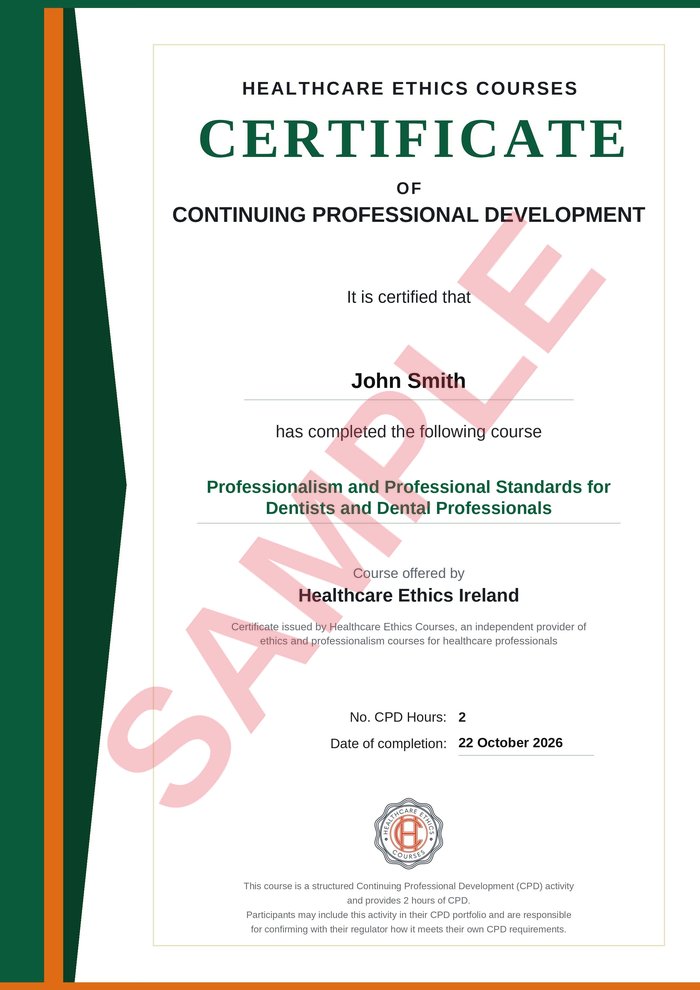
- Certificate issued by Healthcare Ethics Courses on completion, dated, with the course title and 2 CPD hours
- Price
- €100 · from €70 a course (Bulk Buy of 10)
Certificate issued by Healthcare Ethics CoursesRemediation courses for regulatory processes.
The certificate you will receive
How dentists and dental professionals use it
- With a written response to the Fitness to Practise Committee while it considers whether there is a prima facie case, alongside a reflection
- When an undertaking is discussed, or in your evidence at the inquiry
- As a dated record of remediation for the Council when sanction is considered
Who this course is for
Facing an allegation of unprofessional behaviour or professional misconduct
The letter describes how you behaved: a remark to a patient, a record, an advertisement, a post, the way you dealt with a colleague. This course is how you account for it — and show you have remediated.
Dealing with a Dental Council complaint
A patient, a colleague, an employer or the Council itself has applied to the Fitness to Practise Committee for an inquiry. Your written response is where your account first appears; this course gives it a structure.
Before the Fitness to Practise Committee decides
The Committee first considers whether there is a prima facie case. Dated remediation can be shown from this stage onwards.
Facing a fitness to practise inquiry
There is a prima facie case and the Committee will hold the inquiry. Remediation completed before the hearing, dated and documented, is evidence your adviser can put before the Committee and the Council.
Asked about an undertaking
The Council has accepted undertakings from a dentist instead of a High Court application. An undertaking is a promise about your future conduct; a completed course with your reflection attached is evidence it can rest on.
Under conditions, a censure or another sanction
Conditions attached to your registration, a censure or another decision of the Council may ask you to show what you have done to address the concern. The certificate is dated and records 2 CPD hours in professionalism.
The concerns this course speaks to
Professional boundaries with patients and colleagues
A social invitation from a patient accepted, repeated expensive gifts, a relationship with a colleague or a member of staff that went beyond a working one, a dual relationship. A boundaries breach can involve a patient or a colleague. Section 2 has a lesson on professional boundaries, Section 4 one on boundary violations, and Section 6 compares a weak and a strong response to gifts from a patient.
Dishonesty and probity
A false PRSI claim, a record altered to cover a missed periodontal assessment, an advertisement for permanent, risk-free results. Honesty and probity open the core attributes in Section 2, dishonesty opens the lapses in Section 4, and Section 6 compares responses to a record-keeping breach and to financial misconduct.
Communication and respect
A patient told not to be dramatic, pain concerns dismissed, a discriminatory or disrespectful remark to a patient or a member of staff. The course covers respect and dignity, communication and collaboration, poor communication and disrespect as a lapse, and disrespectful communication in two case comparisons.
Records and documentation
An anaesthetic dose not recorded, consent not written down, an entry backdated to look contemporaneous. Section 8 sets out professional documentation — accurate, complete, contemporaneous records, and a late entry made openly rather than backdated — and Section 7 has a hospital dentistry documentation case.
Consent and treatment planning
A root canal begun without explaining extraction or referral, a surgical extraction without the risks set out. Section 6 compares a weak and a strong response to a consent failure, and Section 7 has a community practice case on consent and treatment planning.
Commercial pressure and conflicts of interest
Veneers recommended to every cosmetic patient, an implant where a denture would do, whitening promoted to meet a target. Section 4 covers conflicts of interest and financial misconduct, and Section 7 has a cosmetic dentistry case on commercial pressure.
Online conduct and digital practice
Before-and-after photographs posted without written consent, a personal account used for practice, a tele-dentistry consultation without privacy. Section 4 covers digital misconduct and Section 8 digital professionalism, with the steps that make posting images professional.
Competence and keeping up to date
Signs of oral cancer missed, an outdated technique, knowledge not kept current. The course covers clinical competence as a core attribute and failure to maintain competence as a lapse, with the remediation that answers it.
Facing a Dental Council complaint or fitness to practise inquiry? This course helps you remediate — and show it.
Buy this course — €100 (€70 with Bulk Buy 10)What the course covers
Ten sections and 55 lessons, with a reflective quiz closing each of the first nine and a post-course assessment at the end.
Introduction — Why Professionalism Matters in Irish Dentistry
Five lessons
Core Attributes of Professionalism
Eight lessons
Regulator Perspectives — Dental Council Standards
Six lessons
Lapses in Professionalism and Their Consequences
Seven lessons
Reflection, Insight, and Remediation in Professionalism Cases
Five lessons
Weak vs Strong Demonstrations of Professionalism
Six lessons
Case Studies — Professionalism Across Dental Contexts in Ireland
Six lessons
Professionalism in Communication, Documentation, and Digital Practice
Four lessons
Embedding Professionalism into Identity and Resilience
Six lessons
Conclusion and Key Takeaways
Two lessons, Conclusion and Key Takeaways, and the post-course assessment
Show every lesson title
- Section 01 · Introduction — Why Professionalism Matters in Irish Dentistry
- What Is Professionalism in Dentistry?; Why Professionalism Matters for Patients; Why Professionalism Matters for Regulators; Professionalism as Part of Identity; Consequences of Professionalism Lapses.
- Section 02 · Core Attributes of Professionalism
- Honesty and Probity; Accountability; Respect and Dignity; Clinical Competence; Professional Boundaries; Communication and Collaboration; Reflection and Insight; Resilience and Professional Identity.
- Section 03 · Regulator Perspectives — Dental Council Standards
- The Role of the Dental Council; Core Duties Under the Code; Defining Unprofessional Conduct; Consequences of Professional Lapses; Regulator Expectations in Remediation; Shared Regulator Themes.
- Section 04 · Lapses in Professionalism and Their Consequences
- Dishonesty and Lack of Probity; Poor Communication and Disrespect; Boundary Violations; Failure to Maintain Competence; Conflicts of Interest and Financial Misconduct; Digital Misconduct; Consequences of Professionalism Lapses.
- Section 05 · Reflection, Insight, and Remediation in Professionalism Cases
- Reflection — Honest Self-Examination; Insight — Recognising Seriousness and Impact; Remediation — Corrective Action and Evidence; Weak vs Strong Responses in Dental Council Cases; Integration of Reflection, Insight, and Remediation.
- Section 06 · Weak vs Strong Demonstrations of Professionalism
- Consent Failure; Record-Keeping Breach; Boundary Violation; Financial Misconduct; Disrespectful Communication; Lessons Across Cases.
- Section 07 · Case Studies — Professionalism Across Dental Contexts in Ireland
- Community Practice — Consent and Treatment Planning; Hospital Dentistry — Documentation Failure; Cosmetic Dentistry — Commercial Pressure; Orthodontics — Confidentiality Breach; Emergency Dentistry — Disrespectful Communication; Lessons Across Contexts.
- Section 08 · Professionalism in Communication, Documentation, and Digital Practice
- Professional Communication; Professional Documentation; Digital Professionalism; Integration Across Practice.
- Section 09 · Embedding Professionalism into Identity and Resilience
- Professionalism as Identity; Daily Habits that Reinforce Professionalism; Reflection and Accountability as Ongoing Practice; Building Resilience to Uphold Professionalism; Mentorship and Role Modelling; Sustaining Professionalism Across a Career.
- Section 10 · Conclusion and Key Takeaways
- Conclusion; Key Takeaways.
How to respond to a Dental Council complaint about professionalism
Whether it is read when the Fitness to Practise Committee considers the application, at the inquiry or by the Council on sanction, a written response to a complaint about conduct has to show what you now understand about it. These are the four parts to set out, and what the course gives you for each.
A response that describes what happened but not why it mattered leaves the reader to supply the insight.
- The standardWhich professional attribute or duty the conduct did not meet, named before anyone names it for you.Section 2 sets out eight core attributes of professionalism and Section 3 the core duties under the Dental Council’s Code of Practice.
- What happened and its effectWhat you did, stated plainly, and its effect on the patient, on colleagues and on trust in dentistry.Section 4 sets out six kinds of lapse, from dishonesty and disrespect to digital misconduct, and their consequences.
- Reflection and insightWhy it happened, and why it was serious, without excuses.Section 5 separates reflection, insight and remediation, with weak and strong examples of each.
- What has changedWhat you have done since, with dated evidence that someone else can check.Sections 6 and 7 compare weak and strong responses in ten dental situations — and this course is a dated item of evidence.
An apology without evidence of change reads as a promise; with it, it reads as remediation.
Take advice from your indemnifier, your union or professional body, or a solicitor before you respond to anyone.
Facing a Dental Council complaint or fitness to practise inquiry? This course helps you remediate — and show it.
Buy this course — €100 (€70 with Bulk Buy 10)How this course helps with a Dental Council complaint about conduct
Weak and strong responses in ten situations
Section 6 sets weak and strong responses side by side for a consent failure, a record-keeping breach, gifts from a patient, an inflated PRSI claim and a dismissive remark; Section 7 adds community practice, hospital dentistry, cosmetic dentistry, orthodontics and emergency dentistry. What separates the strong responses is the same each time: an honest admission, a clear link to the Dental Council’s standards, targeted CPD, and evidence that can be checked, such as audits and peer feedback.
Reflection, insight and remediation, kept apart
Section 5 sets out the features of strong reflection and strong insight, and the forms remediation can take: targeted CPD, audits, mentorship or supervision, reflective portfolios, and patient or colleague feedback. No page can tell you what the Committee or the Council will weigh in your case; a dated certificate and a reflection that names the standard are material your adviser can decide how to use. For the stages from the first letter to the High Court, see the fitness to practise process in Ireland, explained.
Read the primary sources
- Dentists Act 1985, section 38 — the application for an inquiry and its grounds
- Code of Practice regarding Professional Behaviour and Ethical Conduct (2022) — Dental Council
- Fitness to Practice — the Dental Council’s own page and its published outcomes
- Dentists Act 1985, section 39 — erasure or suspension from the register
- Dentists Act 1985, section 41 — advice, admonishment or censure
- Dental Council Annual Report 2024
Who wrote it

Dr Shehzad Iqbal
Course author and facilitator, Healthcare Ethics Ireland
Dr Iqbal wrote this course. He combines clinical practice with a formal postgraduate qualification in healthcare law and ethics, and has worked with registrants across the regulated health professions, online and face to face, since 2020.
He founded Probity & Ethics in the United Kingdom in 2020 and Healthcare Ethics Courses, which issues the certificates, in 2025. More about us.
MBBS · MRCS · MRCGP · Postgraduate Certificate in Healthcare Law and Ethics, University of Dundee
Written and reviewed by Dr Shehzad Iqbal. Last reviewed .
In short
Professionalism and Professional Standards for Dentists and Dental Professionals is a two-hour, self-paced remediation course for dentists and dental professionals registered with the Dental Council of Ireland who face a complaint, an application for an inquiry before the Fitness to Practise Committee, an inquiry or a decision on sanction about their behaviour or conduct, written to the Code of Practice regarding Professional Behaviour and Ethical Conduct (2022). It covers eight core attributes of professionalism, from honesty and accountability to boundaries and resilience; the Dental Council’s role and the core duties under its Code; six kinds of lapse and their consequences; reflection, insight and remediation; weak and strong responses in five comparisons and five case studies across community, hospital, cosmetic, orthodontic and emergency dentistry; and professionalism in communication, documentation and digital practice. Ten sections, the first nine closing with a reflective quiz, a post-course assessment, and a dated certificate from Healthcare Ethics Courses. It is remediation and dated evidence of it; it decides no complaint, and it is not a substitute for advice from your indemnifier, your union or professional body, or a solicitor.
When technical skill is not the question
A professionalism complaint about a dentist need not question the dentistry. It can describe a sound filling, a remark that came with it, and a record that does not show what was said. Patients judge a dental visit by the explanation, the charge and the way they were spoken to as well as by the treatment, and a complaint can turn on any of them. The question afterwards is whether the dentist can see the conduct as the patient saw it.
The course sets out the attributes that make up professionalism, the ways each can be breached, and how they apply in the surgery, in the hospital, in records and online. It then separates what a response has to show: reflection on what happened, insight into why it was serious, and remediation that someone else can check.
In a written response, name the attribute or duty the conduct did not meet, say what its effect was, and say what you have changed, with the evidence.
What these words mean
The three terms that decide where a complaint about a dentist goes, and the attributes the course is built on.
- Fitness to Practise Committee
- The Dental Council committee that receives an application for an inquiry, considers whether there is a prima facie case, and holds the inquiry. The Council decides any sanction.
- Professional misconduct
- The first ground in section 38(1) of the Dentists Act 1985. The Council describes it as a serious falling short in the standards expected of a dentist. A finding of professional misconduct may be published without the dentist’s consent (section 38(5)).
- Erasure
- The Dentists Act 1985 word for removal from the register (section 39), where the other Irish Acts say cancellation. The dentist may apply to the High Court within 21 days; otherwise the Council may apply to the Court for confirmation.
The attributes of professionalism and the other terms the course uses
- Professionalism
- Integrity, accountability, competence and respect in every part of dental care, including communication, documentation, financial transparency and digital behaviour, not technical skill alone.
- Accountability
- Taking responsibility for your decisions, errors and omissions: disclosing them, cooperating with an inquiry and taking corrective action.
- Respect and dignity
- Treating patients, colleagues and staff with fairness, courtesy and compassion. Disrespect, discrimination or harassment breaches it.
- Reflection
- A structured account of what happened, why, which standard was engaged, its effect on patients, colleagues and trust, and a plan for change. It goes beyond description.
- Insight
- Understanding why the conduct was wrong and accepting responsibility for it without excuses, including its effect where no harm occurred.
- Remediation
- Practical steps that correct the conduct and prevent it happening again, with evidence someone else can verify: targeted CPD, audits, supervision reports, a reflective portfolio, feedback.
- Digital professionalism
- Applying confidentiality and data protection law online, keeping professional and personal accounts separate, posting no patient images without explicit written consent, and holding tele-dentistry consultations privately and securely.
- Contemporaneous record
- A record made at the time. A late entry made openly, with an explanation, is transparent; a backdated entry is a question of honesty.
The standards and provisions a complaint about a dentist engages
The Dental Council publishes the Code of Practice regarding Professional Behaviour and Ethical Conduct, and an allegation about a dentist is made and decided under the Dentists Act 1985. These are the Code, the grounds, the stages that decide an application for an inquiry and the sections of the Act behind them.
Dental Council — Code of Practice regarding Professional Behaviour and Ethical Conduct (2022)
The Council’s code in force since March 2022, which superseded the earlier Code of Practice on Professional Behaviour and Dental Ethics. The Council says the next revision, expected in 2027 to 2028, will add Open Disclosure Framework requirements. Read it.
For this course: Section 3 sets out the core duties under the Code — the patient’s welfare first, honesty and integrity, dignity and autonomy, confidentiality, competence, clear communication, and no exploitation, conflicts of interest or boundary breaches — so that a response can name the duty engaged.
Section 38 — the application for an inquiry and its grounds
The Council or any person may apply to the Fitness to Practise Committee for an inquiry. The grounds include alleged professional misconduct and alleged unfitness to practise by reason of physical or mental disability; since 6 May 2025 they also include a failure to comply with section 32A and a prohibition or restriction on practising elsewhere. The Council describes professional misconduct as “a serious falling short in the standards expected of a dentist”. Read it.
For this course: The conduct a professionalism allegation describes — dishonesty, disrespect, a boundary, a record, conduct online — is the subject of Sections 2 to 4 and 8.
Section 38(2) to (5) — the prima facie case, the notice and the inquiry
The Fitness to Practise Committee first considers whether there is a prima facie case. If there is, it must hold the inquiry; if not, the Council may decide on no further action or direct an inquiry. Under section 38(4) the dentist receives written notice of the proposed evidence, and under section 38(5) findings are not published without the dentist’s consent, except findings of professional misconduct or of unfitness to practise. Read it.
For this course: Section 5 separates reflection, insight and remediation; a certificate dated before the Committee decides shows you acted before anyone required you to.
Sections 39 to 41 — sanctions and High Court confirmation
After an inquiry the Council may decide on erasure or suspension from the register (section 39), attach conditions to retention on the register (section 40), or advise, admonish or censure (section 41). No fine appears in these sections. The dentist may apply to the High Court within 21 days; otherwise the Council may apply ex parte for confirmation. Since 6 May 2025 advice, admonishment and censure also take effect only on confirmation or once the 21 days pass. Read it.
For this course: The course is dated evidence of remediation completed before the Council decides between advice, admonishment, censure, conditions, suspension and erasure.
Also engaged: Section 44 — an application by the Council to the High Court for suspension; one dentist was suspended this way in 2024 · S.I. 151/2025 — the commencement on 6 May 2025 of the 2020 Act for sections 38 and 41 of the Dentists Act · Patient Safety (Notifiable Incidents and Open Disclosure) Act 2023 — commenced on 26 September 2024, apart from section 68.
What happens after a complaint about a dentist reaches the Dental Council
The stages under the Dentists Act 1985, as amended on 6 May 2025. At each of them three things are worth showing in writing: that you see what was wrong, that you understand why it was serious, and what has changed since, with dated evidence.
An application for an inquiry
In the Dentists Act 1985 a complaint is an application to the Fitness to Practise Committee for an inquiry, and the Council or any person can make one. For mediation the Council points to the Dental Complaints Resolution Service, which is voluntary on both sides, and it has no statutory power to make a dentist redo work.
The Committee considers whether there is a prima facie case
If there is a prima facie case, the Committee must hold the inquiry; if not, the Council may decide on no further action or direct an inquiry regardless. In 2024 two matters had no prima facie evidence and two were sent forward for inquiry (Annual Report 2024).
Written notice of the proposed evidence
Under section 38(4) you receive written notice of the evidence the Committee proposes to hear. No response deadline is published: check your letter, and ask the Council if it does not say. A dated certificate and your reflection are material your adviser can put forward from this point.
Undertakings
The Council’s Annual Report 2024 records: “Undertakings were accepted from another dentist instead of a High Court application”. When an undertaking can be offered, and what it may contain, is not published, so ask your adviser.
The fitness to practise inquiry
The Committee hears the evidence at the inquiry. The Council does not publish whether an inquiry sits in public or in private. In 2024 the Council considered two inquiries under section 38, and one dentist was found guilty of professional misconduct and censured. The Council publishes outcomes on its Fitness to Practice page.
The Council’s sanction and the High Court
The Council decides the sanction: advice, admonishment or censure, conditions, suspension or erasure. You may apply to the High Court within 21 days; otherwise the Council may apply for confirmation (section 39). Since 6 May 2025 advice, admonishment and censure also take effect only on confirmation or once the 21 days pass (section 41). Under section 44 the Council may apply to the High Court for suspension.
Facing a Dental Council complaint or fitness to practise inquiry? This course helps you remediate — and show it.
Buy this course — €100 (€70 with Bulk Buy 10)Not a dentist? Each Irish regulator has its own Act and its own process — courses for doctors, nurses and midwives, pharmacists and all other healthcare professionals, or every course →
Frequently asked questions
What should a response to a Dental Council complaint about my conduct contain?
Four things: the professional attribute or duty the conduct did not meet; what you did and its effect on the patient, colleagues and trust; why it happened and why it was serious, without excuses; and what you have changed, with dated evidence someone else can check. Have your indemnifier, your union or professional body, or a solicitor read it before it is sent.
Should I take advice before I respond to the Council?
Yes — before anything is written to the Council, the Fitness to Practise Committee or your employer. We do not name a particular body here: speak to your indemnifier, your union or professional body, or a solicitor. Nothing on this page is legal advice.
Can this course be used as evidence of remediation in a Dental Council complaint?
It can be part of the evidence, but no course decides a complaint. Whether and how to use a course is for you and your adviser. What this course gives you is a dated certificate and the material for a reflection that names the standard engaged and what has changed.
The complaint is about how I spoke to a patient. Is that a professionalism matter?
It is one of the concerns the course covers in detail: respect and dignity and communication as core attributes (Section 2), poor communication and disrespect as a lapse (Section 4), disrespectful communication in Sections 6 and 7, and professional communication in Section 8 — plain language, checking understanding, and acknowledging a patient’s concerns.
I added to a record after the event. What does the course say?
Section 8 sets out the difference between a late entry made openly, with an explanation, and an entry backdated to look contemporaneous, and Section 6 compares a weak and a strong response to records altered after a missed periodontal assessment. If a complaint has been made, do not alter any record, and take advice before you add to one.
How is this course different from Ethics and Ethical Standards for Dentists and Dental Professionals?
This course is about conduct and behaviour: how you dealt with patients and colleagues, your records, your advertising and your conduct online. The Ethics course is about the reasoning behind a decision: the four principles, the dilemmas in which they conflict and how you account for them. A complaint about how you behaved fits this course; one that says a decision was wrong fits the Ethics course; some complaints need both.
Can this course be part of an undertaking?
It can be part of the evidence. The Dental Council’s Annual Report 2024 records that undertakings were accepted from a dentist instead of a High Court application, but when an undertaking can be offered and what it may contain is not published. Whether a course meets a particular undertaking or condition depends on its wording, so read it with your adviser before you enrol.
How long does it take, and does it count as CPD?
The course is 2 CPD hours, self-paced, with access for twelve months from purchase. The certificate is issued on completion, dated, with the course title and the CPD hours. CPD is not yet mandatory in law for dentists in Ireland, but the Council says “the ethical requirement for dentists to undertake CPD remains unchanged”. Record the course and your reflection in your own CPD record.
Can I get a certificate with a later date?
No. The certificate records the date you completed the course, and that date does not change. If the Council, the Fitness to Practise Committee or an employer asks for recent evidence, you buy the course again: half price within twelve months of your original purchase, the full €100 after that.
Will anyone be told that I am taking the course?
No. Nobody is told you are enrolled. We do not share participant details with the Dental Council, an employer, a union or an indemnifier; the certificate reaches them only if you attach it to your own response.
Courses that work alongside this one
A complaint can raise more than one issue. These are the courses that pair with this one.
Ethics and Ethical Standards for Dentists and Dental Professionals
For a Dental Council complaint about a decision: the four principles, the Code’s key ethical standards, six dilemmas of Irish dental practice, and probity and accountability.
Effective Communication for Healthcare Professionals
Communication with patients and families, difficult and high-risk conversations, handover and escalation, and written and digital communication.
Documentation for Healthcare Professionals
Good clinical documentation, consent and capacity, handover records, digital records and data protection, and records during a complaint.
Professional Boundaries Course
Emotional, sexual, financial and digital boundary breaches, the early warning signs of boundary drift, case studies, and weak and strong responses to a boundary complaint.
Financial Integrity for Healthcare Professionals
Probity in financial dealings, billing, fees and claims, conflicts of interest, gifts and industry relationships, and remediation after a financial lapse.
Social Media Professionalism and Boundaries for Healthcare Professionals
Online identity, patient information, boundaries with patients and colleagues online, personal accounts and privacy settings, and remediation after an online lapse.
Insight for Fitness to Practise
What insight is, weak and strong demonstrations of it, developing it through reflection, and presenting it in a remediation portfolio and at a hearing.
Professionalism and Professional Standards for Dentists and Dental Professionals
This course. The attributes of professionalism in dental practice, the lapses that lead to complaints, and the reflection, insight and remediation a response needs.
See all remediation courses for dentists and dental professionals in Ireland →
Start today, finish at your own pace
Immediate access on purchase. Twelve months' access, a dated certificate on completion, and 2 CPD hours issued by Healthcare Ethics Courses.