
Medical Council · NMBI · Dental Council · Pharmaceutical Society of Ireland · CORU · Complaint or fitness to practise inquiry
Ethical Boundaries with Patients and Colleagues facing a complaint to your regulator or a fitness to practise inquiry about a boundary with a patient or a colleague
A boundary crossed with a patient — or with a colleague?
- Boundaries — a boundaries breach with a patient or a colleague: a relationship that went beyond a professional one
- Dual relationships — a friendship or a second role alongside the professional relationship
- Hierarchy — a junior colleague pressured, or seniority used to intimidate
- Bullying — a colleague belittled or undermined, in private or in front of patients
- Conflicts of interest — referrals to a service run by a colleague or a friend, not declared
- Gifts — repeated or expensive gifts or favours from a patient or their family
- Digital — a patient’s friend request accepted, or a colleague criticised online
- Any other concern — about respect, fairness or professional distance at work
Facing a complaint or a fitness to practise inquiry about a boundary with a patient or a colleague — before the Medical Council, NMBI, the Dental Council, the Pharmaceutical Society of Ireland or CORU?
This course is for a healthcare professional facing a complaint or a fitness to practise inquiry about a boundary with a patient or a colleague. This course helps you remediate — and show the remediation, with a dated certificate for your written response, your reflection, an undertaking or an inquiry.
| Courses | Price per course | You save |
|---|---|---|
| 1 | €100 | No saving |
| 2 | €88 | €25 |
| 3 | €83 | €50 |
| 5 | €80 | €100 |
| 10 | €70 | €300 |
Add courses. The saving is applied in the basket.
Immediate access · certificate on completion · twelve months' access
- 2 CPD hours
- Self-paced
- Written for Ireland
- CPD certificate
- From €70 a course (Bulk Buy of 10)
 Dr Shehzad IqbalFounder, course author and facilitatorMBBS, MRCS, MRCGP
 Dr Mo MirzaCourse facilitatorMedically trained, UCL London
 Ludmila UpenieceBusiness development and supportPsychology, UEL London
At a glance
- Who it is for
- Any healthcare professional in Ireland facing a complaint, an employer process or a fitness to practise inquiry about a boundary with a patient or a colleague: a dual relationship, gifts, financial exploitation, bullying, misuse of hierarchy or an undeclared conflict of interest
- Regulator covered
- Applies to practitioners registered with the Medical Council, the Nursing and Midwifery Board of Ireland (NMBI), the Dental Council, the Pharmaceutical Society of Ireland (PSI) or CORU
- Length
- 11 sections, 58 lessons, 2 CPD hours
- Format
- Self-paced, online, immediate access, twelve months from purchase
- Certificate
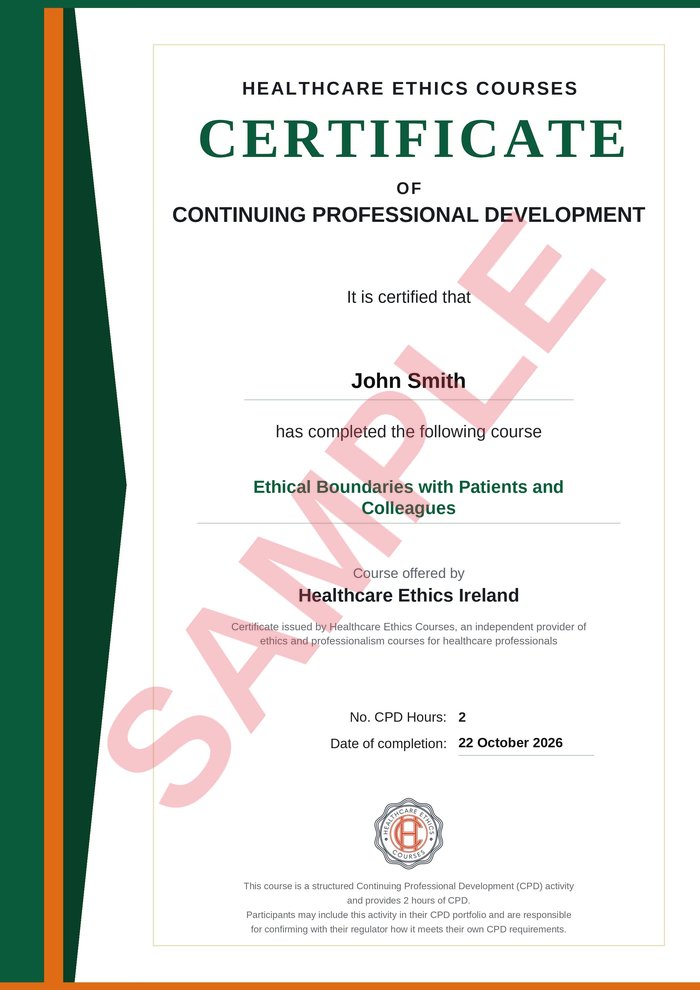
- Certificate issued by Healthcare Ethics Courses on completion, dated, with the course title and 2 CPD hours
- Price
- €100 · from €70 a course (Bulk Buy of 10)
Certificate issued by Healthcare Ethics CoursesRemediation courses for regulatory processes.
The certificate you will receive
How healthcare professionals use it
- With a written response to your regulator or its preliminary committee, alongside a reflection
- When an undertaking or a consent is discussed, or in your evidence to an inquiry committee
- As a dated record of remediation for the regulator when sanction is considered
Who this course is for
Facing an allegation about a patient relationship
Emotional over-involvement, a relationship with a patient, costly treatment without the alternatives, a friend request accepted. Section 3 covers emotional, sexual, financial and digital boundaries with patients.
Facing a complaint from a colleague
A junior colleague, a team member or a manager has raised your behaviour: belittling, intimidation, favouritism, pressure to act. Section 4 covers hierarchy and professional power, respect in teamwork, bullying and harassment, and conflicts of interest between colleagues.
Facing a complaint to your regulator
The Medical Council, NMBI, the Dental Council, the PSI or CORU has written to tell you of a complaint. Your first written reply is where your understanding of the boundary is read first. Section 9 sets out what a response should include.
Facing an allegation of bullying or misuse of hierarchy
Section 7 follows a pharmacist who belittled junior staff in front of patients and a senior doctor who pressured a trainee to alter clinical notes, and Section 9 sets weak and strong responses to both side by side.
Told the relationship became too close
Over-familiarity, private communication, emotional support beyond your role, with a patient or a colleague. Section 6 covers the early warning signs of boundary drift and how to prevent it.
Facing a fitness to practise inquiry
The complaint has gone to a Fitness to Practise Committee, a Professional Conduct Committee or a Health Committee. Remediation completed before the hearing, dated and documented, is evidence you can put before the committee and the regulator.
The concerns this course speaks to
Emotional over-involvement
Sharing personal problems with a patient, becoming a patient’s friend, offering counselling-type support beyond your role. Sections 3 and 6 cover emotional involvement and blurred support roles, and Section 7 a nurse’s over-involvement with a patient.
Sexual relationships and harassment
A relationship with a current patient, or harassment of a colleague. Section 2 covers sexual conduct with patients and colleagues, and Section 8 places sexual exploitation and harassment among breaches incompatible with practice.
Financial exploitation and gifts
Costly treatment without the simpler options, repeated gifts or favours. Sections 2 and 3 cover financial and conflict-of-interest limits, and Section 7 a dentist’s financial exploitation of patients.
Professional boundaries with a patient or a colleague
The course gives colleagues a section of their own — hierarchy and professional power, respect in teamwork, bullying and harassment, and conflicts of interest between colleagues (Section 4) — with three colleague case studies (Section 7). With a patient, it covers professional distance and the dual relationships that compromise objectivity (Section 2).
Bullying and misuse of hierarchy
A junior colleague belittled in front of patients, a trainee pressured to alter records, tasks assigned to favourites. Sections 4 and 6 cover bullying, power misuse and workplace favouritism, and Section 9 compares weak and strong responses.
Conflicts of interest between colleagues
Referrals to a clinic co-owned by a colleague, or to a service run by a friend, not disclosed. Section 4 covers conflicts of interest between colleagues, and Section 7 a social worker’s undisclosed referrals.
Digital and social media conduct
A patient’s friend request accepted, a personal WhatsApp number given out, a colleague criticised on Facebook. Sections 2 and 3 cover digital conduct with patients and colleagues, and Section 9 a weak and a strong response to a digital breach.
Consequences and severity
Harm to patients, damage to team culture, sanctions for the professional. Section 8 covers the consequences of breaches and how they are ranked by severity, from lapses addressed with advice to breaches incompatible with practice.
Facing a complaint to your regulator or a fitness to practise inquiry? This course helps you remediate — and show it.
Buy this course — €100 (€70 with Bulk Buy 10)What the course covers
Eleven sections and 58 lessons, with a reflective quiz closing each of the first ten and a post-course assessment at the end.
Introduction — Why Ethical Boundaries Matter in Irish Healthcare
Four lessons
Core Principles of Ethical Boundaries
Eight lessons
Boundaries with Patients — Emotional, Sexual, Financial, Digital
Five lessons
Boundaries with Colleagues — Hierarchy, Respect, Bullying, Conflicts of Interest
Five lessons
Regulator Perspectives — Irish Standards on Boundaries
Six lessons
Early Warning Signs of Boundary Drift
Six lessons
Case Studies — Boundary Lapses with Patients and Colleagues
Six lessons
Consequences of Boundary Breaches
Four lessons
Weak vs Strong Responses in Boundary Complaints
Five lessons
Embedding Boundaries into Professional Identity and Resilience
Seven lessons
Conclusion and Key Takeaways
Two lessons, Conclusion and Key Takeaways, and the post-course assessment
Show every lesson title
- Section 01 · Introduction — Why Ethical Boundaries Matter in Irish Healthcare
- Why Boundaries with Patients Matter; Why Boundaries with Colleagues Matter; Boundary Breaches as Ethical Misconduct; The Role of Regulators.
- Section 02 · Core Principles of Ethical Boundaries
- Respect and Dignity; Professional Distance; Sexual Boundaries; Financial and Conflict-of-Interest Boundaries; Communication Boundaries; Digital and Social Media Boundaries; Accountability and Transparency; Shared Professional Duty.
- Section 03 · Boundaries with Patients — Emotional, Sexual, Financial, Digital
- Emotional Boundaries; Sexual Boundaries; Financial Boundaries; Digital Boundaries; Shared Regulator Perspective.
- Section 04 · Boundaries with Colleagues — Hierarchy, Respect, Bullying, Conflicts of Interest
- Hierarchy and Professional Power; Respect in Teamwork; Bullying and Harassment; Conflicts of Interest Between Colleagues; Shared Regulator Expectations.
- Section 05 · Regulator Perspectives — Irish Standards on Boundaries
- Medical Council of Ireland; Nursing and Midwifery Board of Ireland (NMBI); Pharmaceutical Society of Ireland (PSI); Dental Council of Ireland; CORU — Health and Social Care Professionals Council; Shared Regulator Themes.
- Section 06 · Early Warning Signs of Boundary Drift
- Over-Familiarity with Patients or Colleagues; Secretive or Selective Communication; Acceptance of Gifts or Favours; Emotional Support That Confuses Roles; Workplace Favouritism or Power Misuse; Preventing Boundary Drift.
- Section 07 · Case Studies — Boundary Lapses with Patients and Colleagues
- Patient Case — Emotional Over-Involvement; Patient Case — Financial Exploitation; Colleague Case — Bullying Behaviour; Colleague Case — Misuse of Hierarchy; Colleague Case — Conflict of Interest; Shared Lessons Across Cases.
- Section 08 · Consequences of Boundary Breaches
- Consequences for Patients; Consequences for Professionals; Consequences for the Profession; Levels of Breach Severity.
- Section 09 · Weak vs Strong Responses in Boundary Complaints
- Patient Case — Digital Boundary Breach; Patient Case — Financial Misconduct; Colleague Case — Bullying Behaviour; Colleague Case — Misuse of Hierarchy; Shared Regulator Perspective.
- Section 10 · Embedding Boundaries into Professional Identity and Resilience
- Boundaries as Part of Identity; Daily Boundary Habits; Reflection as a Boundary Safeguard; Accountability and Supervision; Building Resilience to Protect Boundaries; Mentorship and Role Modelling; Sustaining Boundaries Across a Career.
- Section 11 · Conclusion and Key Takeaways
- Conclusion; Key Takeaways.
How to respond to a boundary complaint or fitness to practise inquiry
Whether it is read by your employer, a preliminary committee or an inquiry committee, a response to a boundary complaint is read for how you will use your position from now on, with patients and with colleagues. These are the four parts to set out, and what the course gives you for each.
Whether the other person was a patient or a colleague, the response shows how you will use your position next time.
- What happenedThe behaviour, named plainly, with a patient or a colleague.Sections 3 and 4 set out boundaries with patients and with colleagues.
- The standardThe expectation in your regulator’s code that it breached.Section 5 applies boundaries with patients and colleagues to doctors, nurses and midwives, pharmacists, dentists and the CORU professions.
- The effectOn the patient’s trust and care, or on the colleague, the team and patient safety.Section 8 covers the consequences for patients, professionals and the profession, including workplace culture.
- What has changedTargeted CPD, supervision, feedback systems, declared interests — documented.Section 9 covers the features strong responses share — and this course is a dated item for your portfolio.
I was only motivating them describes an intention; the complaint is about its effect on a colleague.
Take advice from your indemnifier, your union or professional body, or a solicitor before you respond to anyone.
Facing a complaint to your regulator or a fitness to practise inquiry? This course helps you remediate — and show it.
Buy this course — €100 (€70 with Bulk Buy 10)How this course helps with a complaint or fitness to practise inquiry
Patients and colleagues in the codes
The NMBI Code (2025) says a nurse or midwife must not use their professional position to “form a relationship of a sexual, emotional or exploitative nature”, and asks them to “treat colleagues with respect”; Respect and Collaboration are among its six principles, and working with others is one of the seven principles of the PSI Code of Conduct. In the cases CORU concluded in 2022 to 2024, professional boundaries were a theme in 7% and communication in 39% (trends report). The course covers boundaries with patients (Section 3) and with colleagues (Section 4).
Insight and the response
The Medical Council’s Guidance on Sanctions says a doctor may present evidence of how they have addressed issues or concerns, and NMBI’s Guidance on Sanctions lists acknowledgement and early admission, and evidence of an apology, among mitigating factors. CORU’s trends report records a committee finding that “early admissions had demonstrated some limited insight”. Section 7 compares weak and strong responses in five case studies, and Section 9 in four boundary complaints, two with patients and two with colleagues. For the stages from the first letter to the High Court, see the fitness to practise process in Ireland, explained.
Read the primary sources
- Code of Professional Conduct and Ethics for Registered Nurses and Registered Midwives (2025)
- Code of Conduct for pharmacists — Pharmaceutical Society of Ireland
- Guide to Professional Conduct and Ethics for Registered Medical Practitioners, 9th edition (2024)
- Code of Practice regarding Professional Behaviour and Ethical Conduct — Dental Council
- Codes of Professional Conduct and Ethics — CORU
- CORU fitness to practise trends report (2022 to 2024)
- Guidance on Sanctions Imposed by the Medical Council (28 May 2024)
- Guidance on Sanctions — Nursing and Midwifery Board of Ireland
Who wrote it

Dr Shehzad Iqbal
Course author and facilitator, Healthcare Ethics Ireland
Dr Iqbal wrote this course. He combines clinical practice with a formal postgraduate qualification in healthcare law and ethics, and has worked with registrants across the regulated health professions, online and face to face, since 2020.
He founded Probity & Ethics in the United Kingdom in 2020 and Healthcare Ethics Courses, which issues the certificates, in 2025. More about us.
MBBS · MRCS · MRCGP · Postgraduate Certificate in Healthcare Law and Ethics, University of Dundee
Written and reviewed by Dr Shehzad Iqbal. Last reviewed .
In short
Ethical Boundaries with Patients and Colleagues is a two-hour, self-paced remediation course for healthcare professionals in Ireland — registered with the Medical Council, NMBI, the Dental Council, the Pharmaceutical Society of Ireland or CORU — who face a complaint or a fitness to practise inquiry about a boundary with a patient or a colleague. It covers why boundaries with patients and with colleagues matter; the core principles, from respect and professional distance to sexual, financial, communication and digital boundaries; boundaries with patients — emotional, sexual, financial and digital; boundaries with colleagues — hierarchy, respect, bullying and conflicts of interest; boundaries across the professions; the early warning signs of boundary drift; case studies with patients and colleagues; the consequences and severity of breaches; weak and strong responses in boundary complaints; and embedding boundaries in identity and resilience. Eleven sections, the first ten closing with a reflective quiz, a post-course assessment, and a dated certificate from Healthcare Ethics Courses. It is remediation and dated evidence of it; it decides no complaint, and it is not a substitute for advice from your indemnifier, your union or professional body, or a solicitor.
Ethical boundaries with patients and with colleagues
Ethical boundaries define the limits within which trust, safety and dignity are kept — with patients and with colleagues. With patients, the course covers emotional, sexual, financial and digital boundaries, and the power imbalance that makes a breach serious (Section 3). With colleagues, it covers hierarchy and professional power, respect in teamwork, bullying and harassment, and conflicts of interest between colleagues (Section 4): breaches that damage workplace culture and, through it, patient care.
Professional distance applies to both: over-familiarity, with a patient or a colleague, compromises objectivity (Sections 2 and 6), and so does a dual relationship with a patient (Section 2); boundary drift — small lapses such as private communication, gifts or favouritism — can escalate into a breach if it is not addressed (Section 6).
In a written response, name the boundary and whether it involved a patient or a colleague, the standard it breached, its effect, and the safeguards now in place.
What these words mean
The three terms that decide where a complaint goes, and the words the course is built on.
- Preliminary Proceedings Committee
- The committee of the Medical Council, NMBI, the PSI and CORU that looks at a complaint before any inquiry: it may take no further action, suggest mediation, conclude the matter with an undertaking or a consent where its Act allows, or refer the complaint to an inquiry. At the Dental Council, the Fitness to Practise Committee considers whether there is a prima facie case.
- Fitness to practise inquiry
- The hearing stage: before the Fitness to Practise Committee at the Medical Council, NMBI and the Dental Council, and before the Professional Conduct Committee or the Health Committee at the PSI and CORU. Any sanction heavier than an advice, admonishment or censure takes effect only when the High Court confirms it.
- Professional misconduct
- A ground of complaint under the Medical Practitioners, Nurses and Midwives, Pharmacy and Health and Social Care Professionals Acts, and a ground for an application for an inquiry under the Dentists Act. The Dental Council describes it as a serious falling short in the standards expected of a dentist; the PSI as behaviour that goes against its Code of Conduct for registered pharmacists; CORU as any act, omission or pattern of conduct that breaches the Code.
Boundary drift, misuse of hierarchy and the other terms the course uses
- Ethical boundaries
- The limits that keep professional relationships with patients and colleagues respectful, fair and free from exploitation.
- Boundary drift
- Small lapses — over-familiarity, secretive communication, gifts or favours, favouritism — that gradually blur professional and personal lines.
- Dual relationship
- A second relationship, such as a friendship, alongside the professional one. The course treats dual relationships that compromise objectivity as a breach of professional distance.
- Misuse of hierarchy
- Using a senior position to exploit, intimidate or pressure a colleague, such as pressing a trainee to alter records.
- Bullying and harassment
- Behaviour that belittles, undermines or intimidates a colleague; the course treats it as incompatible with professional standards.
- Conflict of interest
- A personal or financial interest that could bias a professional decision or create an unfair advantage, with a patient or between colleagues.
- Professional distance
- Keeping relationships objective: no over-familiarity, favouritism or personal friendships that blur the professional role.
- Remediation
- Targeted CPD, reflective writing, supervision and documented safeguards such as audits, feedback systems and policies, linked to the boundary concern.
The Acts a complaint is made and decided under
Ireland’s five health regulators each work under their own Act, all five amended by the Regulated Professions (Health and Social Care) (Amendment) Act 2020. These are the sections that say who may complain, on what grounds, and who looks at the complaint first.
Medical Council — Medical Practitioners Act 2007, section 57
A person, including the Council, may complain to the chief executive officer. The grounds include professional misconduct, poor professional performance, a relevant medical disability, and a failure to comply with a condition, an undertaking or a consent. The chief executive officer looks at the complaint first, an Authorised Officer may gather the facts, and the Preliminary Proceedings Committee decides whether there is enough cause to take further action. Read it.
For this course: Section 5 applies boundaries with patients and colleagues to doctors, and Section 9 covers a response to misuse of hierarchy with a trainee.
NMBI — Nurses and Midwives Act 2011, section 55
A person, including the Board, may complain to the chief executive officer. The grounds include professional misconduct, poor professional performance, non-compliance with a code of professional conduct, a relevant medical disability, and an irregularity in relation to the custody, prescription or supply of a controlled drug. A Preliminary Proceedings Committee, assisted by a case officer, may refer a complaint to the Fitness to Practise Committee for a sworn oral inquiry. Read it.
For this course: The NMBI Code addresses relationships of a sexual, emotional or exploitative nature and respect for colleagues; Section 9 covers a response to a digital boundary breach.
Dental Council — Dentists Act 1985, section 38
The Council or any person may apply to the Fitness to Practise Committee for an inquiry, on grounds that include alleged professional misconduct and alleged unfitness to practise by reason of physical or mental disability. The Fitness to Practise Committee considers whether there is a prima facie case, and if there is, it holds the inquiry. Read it.
For this course: Section 5 applies boundaries to dentists, including workplace relationships, and Section 9 covers a response to financial misconduct.
Pharmaceutical Society of Ireland — Pharmacy Act 2007, section 35
A complaint may be made in writing by or on behalf of any person, or by the registrar. The grounds include professional misconduct, poor professional performance, the effect on practice of a physical or mental ailment, emotional disturbance, or alcohol or drug addiction, and a failure to comply with a condition or an undertaking. The PSI separates a concern from a statutory complaint, which is for issues of a serious nature; its Preliminary Proceedings Committee may refer a complaint to a committee of inquiry or to mediation. Read it.
For this course: Section 5 applies boundaries to pharmacists, including fairness and respect to pharmacy colleagues, and Section 9 covers a response to bullying.
CORU — Health and Social Care Professionals Act 2005, section 52
A complaint may be made to the Council by or on behalf of any person, or by a registration board. The grounds include professional misconduct, which CORU describes as any act, omission or pattern of conduct that breaches the Code, and poor professional performance. The Preliminary Proceedings Committee screens out complaints that are trivial, vexatious, without substance or made in bad faith; the Professional Conduct Committee deals with conduct or competence, and the Health Committee with whether a registrant’s health is affecting their ability to practise. Read it.
For this course: Professional boundaries were a theme in 7% of the cases CORU concluded in 2022 to 2024; Section 7 covers a social worker’s undisclosed conflict of interest.
Also engaged: Sanctions — advice, admonishment or censure, conditions, suspension and cancellation (erasure under the Dentists Act): Medical Practitioners Act s.71, Nurses and Midwives Act s.69, Dentists Act ss.39 to 41, Pharmacy Act s.48, Health and Social Care Professionals Act s.66 · High Court confirmation — the heavier sanctions take effect only when the High Court confirms them; an advice, admonishment or censure on confirmation or once the appeal window of 21 or 30 days passes without an appeal · The 2020 Act — the Regulated Professions (Health and Social Care) (Amendment) Act 2020, which amended all five Acts in stages from 2021 to 2025.
What happens after a complaint reaches an Irish regulator
Each regulator has its own Act and its own names for the stages, and your letter tells you which stage you are at. At each of them the same three things are worth showing in writing: that you see what went wrong, that you understand it against your regulator’s code, and what you have changed, with dated evidence.
The complaint and the grounds
Anyone may complain, including the regulator itself. Under the Medical Practitioners Act and the Nurses and Midwives Act the complaint goes to the chief executive officer; under the Pharmacy Act it may be made by or on behalf of any person or by the registrar; under the Health and Social Care Professionals Act by or on behalf of any person or by a registration board. Under the Dentists Act the Council or any person applies to the Fitness to Practise Committee for an inquiry. Professional misconduct is a ground of complaint under the four other Acts and, under the Dentists Act, a ground for an application for an inquiry.
The preliminary stage
The Medical Council, NMBI, the PSI and CORU each have a Preliminary Proceedings Committee. At the Medical Council the chief executive officer looks at a complaint first and may assign an Authorised Officer, and the committee decides whether there is enough cause to take further action. At NMBI the committee may refer a complaint to the Fitness to Practise Committee for a sworn oral inquiry, or suggest mediation or informal resolution; at the PSI it may refer a complaint to a committee of inquiry or to mediation; at CORU it screens out complaints that are trivial, vexatious, without substance or made in bad faith. At the Dental Council, the Fitness to Practise Committee considers whether there is a prima facie case.
Undertakings, consents and mediation
A complaint can be concluded by agreement in some cases. At the Medical Council’s preliminary stage a doctor may be asked to undertake not to repeat the conduct, or to consent to censure (2025 procedures). At NMBI in 2024, 12 undertakings or consents concluded matters at the preliminary stage and the Fitness to Practise Committee recommended 32 (State of Complaints 2024). Undertakings were the largest single Committee of Inquiry outcome in the cases CORU concluded in 2022 to 2024: 13, against 7 censures (trends report). In 2024 the Dental Council accepted undertakings from a dentist instead of making a High Court application (Annual Report 2024). Mediation at NMBI and CORU needs the consent of both sides.
The inquiry
The inquiry committee is the Fitness to Practise Committee at the Medical Council, NMBI and the Dental Council, and the Professional Conduct Committee or the Health Committee at the PSI and CORU. At NMBI allegations against a nurse or midwife must be proven beyond reasonable doubt. Medical Council inquiries are held in public unless the Council decides on a hearing in private or part private (Medical Council); CORU says its Professional Conduct Committee hearings are normally held in public and its Health Committee hearings normally in private.
The sanction and the High Court
Sanctions run from advice, admonishment or censure (admonishment or censure at the PSI and CORU) through conditions and suspension to cancellation, called erasure under the Dentists Act (MPA s.71, NMA s.69, Dentists Act s.39, Pharmacy Act s.48, HSCP Act s.66). The heavier sanctions take effect only when the High Court confirms them; an advice, admonishment or censure takes effect on confirmation or once the appeal window passes without an appeal: 21 days for doctors, nurses, midwives and dentists, 30 days for pharmacists and CORU registrants (MPA s.74, NMA s.72, Dentists Act s.41, Pharmacy Act s.50, HSCP Act s.68).
Interim measures and your first reply
Separately, the Medical Council says interim suspension is possible under section 60 of the Medical Practitioners Act 2007; where there is a serious and immediate risk, the PSI’s Council can seek suspension from the High Court; and the Dental Council may apply to the High Court for suspension under section 44 of the Dentists Act. None of the five regulators publishes a fixed deadline for a first reply: the Medical Council gives not less than two weeks to respond to an Investigation Report, and NMBI says you may request an extension of time. Take advice before you reply.
Facing a complaint to your regulator or a fitness to practise inquiry? This course helps you remediate — and show it.
Buy this course — €100 (€70 with Bulk Buy 10)Courses with the Ethics and Professionalism pair written to your own regulator’s code — for doctors, nurses and midwives, dentists, pharmacists and all other healthcare professionals, or every course →
Frequently asked questions
Can a boundary breach involve a colleague rather than a patient?
Yes. The course gives colleagues a section of their own: hierarchy and professional power, respect in teamwork, bullying and harassment, and conflicts of interest between colleagues (Section 4), with case studies on bullying, misuse of hierarchy and an undisclosed conflict of interest (Section 7).
I have been accused of bullying a colleague. What should my response show?
That you see the behaviour as the colleague experienced it, not only as you intended it; which standard of respect and dignity it breached; and what you have changed. Section 9 sets a weak response (I was only motivating them) beside a strong one: an apology, targeted CPD in leadership, and anonymous staff feedback systems.
What is a dual relationship?
A second relationship, such as a friendship, alongside the professional one. The course treats a dual relationship with a patient that compromises objectivity as a breach of professional distance (Section 2), covers over-familiarity with patients or colleagues (Section 6), and covers declaring conflicts of interest openly (Sections 4 and 7).
What is boundary drift?
Small lapses that gradually blur professional and personal lines: over-familiarity with a patient or a colleague, private texts or meetings, repeated small gifts or favours, emotional support beyond your role, favouritism at work. Section 6 sets out the warning signs and how to prevent drift through transparency, policies, supervision and reflection.
Should I take advice before I respond?
Yes — before anything is written to the regulator, a committee or your employer. Ask your indemnifier, your union or professional body, or a solicitor to read your response before it is sent, and keep a copy of everything you send. Nothing on this page is legal advice.
Can this course be used as evidence of remediation?
It can be part of the evidence, but no course decides a complaint. It gives you a dated certificate of 2 CPD hours. Section 9 shows what strong responses share: admission of responsibility, the regulator standard named, targeted CPD, and documented safeguards such as audits, policies and supervision.
How long does it take, and how long do I have access?
The course is 2 CPD hours, self-paced, with access for twelve months from purchase. The certificate is issued on completion, dated, with the course title and the CPD hours. Whether the hours count towards your own CPD requirement is for your regulator or scheme to say: doctors must undertake a minimum of 50 hours in each scheme year, and CORU registrants must achieve 30 CPD credits in every 12-month period.
Can I get a certificate with a later date?
No. The certificate records the date you completed the course, and that date does not change. If your regulator, an inquiry committee or an employer asks for recent evidence, you buy the course again: half price within twelve months of your original purchase, the full €100 after that.
Will anyone be told that I am taking the course?
No. Nobody is told you are enrolled. We do not share participant details with any regulator, an employer, a union or an indemnifier; the certificate reaches them only if you attach it to your own response.
Courses that work alongside this one
Boundaries with patients and colleagues meet teamwork, money and online conduct. These are the courses that pair with this one.
Professional Boundaries Course
Emotional, sexual, financial and digital boundary breaches, early warning signs of boundary drift, case studies, and weak and strong responses to a boundary complaint.
Ensuring Teamwork and Collaboration
Roles within teams, communication, managing disagreement, raising concerns, and teamwork failures, complaints and investigations.
Social Media Professionalism and Boundaries for Healthcare Professionals
Confidentiality and identifiability online, boundaries with patients and colleagues online, personal accounts and privacy settings, and remediation after an online lapse.
Financial Integrity for Healthcare Professionals
Billing, fees and claims, conflicts of interest, gifts and sponsorship, prescribing and referrals, and remediation after a financial concern.
Professional Ethics Course
Probity, boundaries and conflicts of interest, digital professionalism, weak and strong demonstrations of professional ethics, and ethical portfolios.
Insight for Fitness to Practise
What insight is, how the five regulators frame it, weak and strong demonstrations of insight, and how insight is shown in a portfolio and at a hearing.
Remediation for Fitness to Practise
What a regulator looks for in remediation, what a remediation portfolio contains, case studies across five professions, and remediation at a hearing.
Ethical Boundaries with Patients and Colleagues
This course. Boundaries with patients and with colleagues: hierarchy, bullying, conflicts of interest, boundary drift, case studies, and weak and strong responses.
Start today, finish at your own pace
Immediate access on purchase. Twelve months' access, a dated certificate on completion, and 2 CPD hours issued by Healthcare Ethics Courses.