
Medical Council · NMBI · Dental Council · Pharmaceutical Society of Ireland · CORU · Complaint or fitness to practise inquiry
Ensuring Teamwork and Collaboration facing a complaint to your regulator or a fitness to practise inquiry about how they work with colleagues
A complaint about how you worked with the team, rather than what you knew?
- Handover — information not passed on, or a handover that left a task without an owner
- Escalation — a concern not raised, or not taken further when nothing was done
- Conflict — a disagreement with a colleague that became personal or public
- Behaviour — dismissive, intimidating or undermining behaviour reported by colleagues
- Records — MDT decisions and action points not recorded, or not followed up
- Delegation — a task delegated without checking competence or arranging supervision
- Accountability — it was a team decision offered as the answer to an individual allegation
- Any other concern — about how you communicate or work within a team
Facing a complaint or a fitness to practise inquiry about teamwork, communication or behaviour towards colleagues — before the Medical Council, NMBI, the Dental Council, the Pharmaceutical Society of Ireland or CORU?
This course is for a healthcare professional whose teamwork, communication or behaviour towards colleagues is the subject of a complaint or a fitness to practise inquiry. This course helps you remediate — and show the remediation, with a dated certificate for your written response, your reflection, an undertaking or an inquiry.
| Courses | Price per course | You save |
|---|---|---|
| 1 | €100 | No saving |
| 2 | €88 | €25 |
| 3 | €83 | €50 |
| 5 | €80 | €100 |
| 10 | €70 | €300 |
Add courses. The saving is applied in the basket.
Immediate access · certificate on completion · twelve months' access
- 2 CPD hours
- Self-paced
- Written for Ireland
- CPD certificate
- From €70 a course (Bulk Buy of 10)
 Dr Shehzad IqbalFounder, course author and facilitatorMBBS, MRCS, MRCGP
 Dr Mo MirzaCourse facilitatorMedically trained, UCL London
 Ludmila UpenieceBusiness development and supportPsychology, UEL London
At a glance
- Who it is for
- Any healthcare professional in Ireland facing a complaint, an employer investigation or a fitness to practise inquiry about handover, escalation, delegation, conflict or behaviour within a team
- Regulator covered
- Applies to practitioners registered with the Medical Council, the Nursing and Midwifery Board of Ireland (NMBI), the Dental Council, the Pharmaceutical Society of Ireland (PSI) or CORU
- Length
- 10 sections, 60 lessons, 2 CPD hours
- Format
- Self-paced, online, immediate access, twelve months from purchase
- Certificate
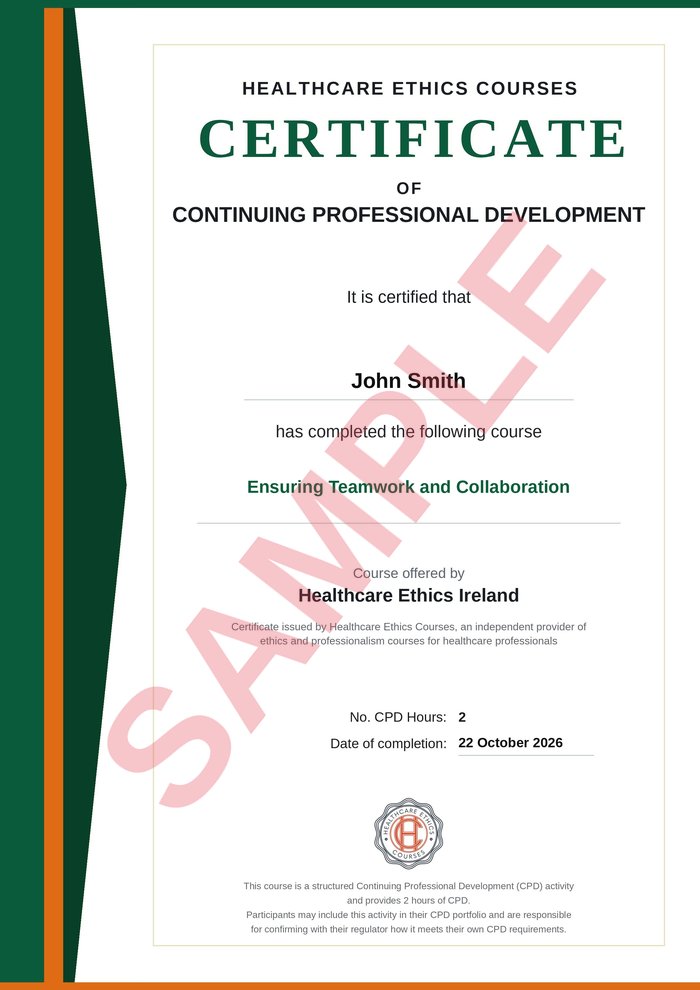
- Certificate issued by Healthcare Ethics Courses on completion, dated, with the course title and 2 CPD hours
- Price
- €100 · from €70 a course (Bulk Buy of 10)
Certificate issued by Healthcare Ethics CoursesRemediation courses for regulatory processes.
The certificate you will receive
How healthcare professionals use it
- With a written response to your regulator or its preliminary committee, alongside a reflection
- When an undertaking or a consent is discussed, or in your evidence to an inquiry committee
- As a dated record of remediation for the regulator when sanction is considered
Who this course is for
Facing a complaint that began with the team
A colleague, a manager or your employer raised the concern, or a patient complained of conflicting advice and delay. Section 7 covers how teamwork issues lead to complaints, and how a complaint about communication or attitude can widen to competence or professionalism.
Facing a complaint to your regulator
The Medical Council, NMBI, the Dental Council, the PSI or CORU has written to tell you of a complaint. Your first written reply is where your account of your part in the team is read first. Section 7 sets out what a response should include.
Facing an employer investigation or incident review
Investigations look at how the team functioned as well as at what you did: how information was shared, whether concerns were raised, how decisions were recorded. Section 8 covers how teamwork issues are investigated, team dynamics and evidence gathering, and your behaviour during the process.
Your answer was: it was a team decision
You said it was a team decision, or that you followed instructions. Sections 2 and 8 explain why accountability remains individual in team-based care, and what that means for the response you write.
Facing an allegation about your behaviour towards colleagues
Public criticism of a colleague, aggressive or intimidating communication, a colleague undermined in front of patients. Section 5 covers conflict, behaviour and regulatory risk, and Section 7 behavioural issues and team dynamics.
Facing a fitness to practise inquiry
The complaint has gone to a Fitness to Practise Committee, a Professional Conduct Committee or a Health Committee. Remediation completed before the hearing, dated and documented, is evidence you can put before the committee and the regulator.
The concerns this course speaks to
Handover and information sharing
A handover that was incomplete or rushed, a result not passed on, an assumption that someone else had the information. Section 3 covers structured communication and handover, and Section 4 information sharing within multidisciplinary teams.
Speaking up and escalation
A concern noticed but not raised, or raised once and dropped. Section 6 covers raising concerns as a professional duty, the barriers to speaking up, escalation pathways, documenting the concern, and what to do when concerns are not acted upon.
Disagreement and conflict
A clinical disagreement that became personal, or a conflict left to grow. Section 5 covers professional expectations when disagreements arise, challenging decisions safely, hierarchy and psychological safety, and managing ongoing conflict.
Respect towards colleagues
Disrespect towards a colleague, public criticism or humiliation, a colleague undermined in front of patients. The course treats behaviour towards colleagues as part of professionalism (Section 3) and a source of regulatory risk (Section 5), and covers the visible tension that patients experience as a teamwork failure (Section 7). For a boundary concern with a colleague, see Ethical Boundaries with Patients and Colleagues.
Roles, delegation and supervision
Unclear roles, a task delegated without confirming competence, supervision not arranged. Section 2 covers roles, scope of practice and accountability, delegation and supervision; Section 7 role confusion and accountability gaps.
Multidisciplinary team decisions
An MDT plan that was not recorded, a disagreement that was suppressed, a decision you agreed with but thought unsafe. Section 4 covers decision-making and accountability in MDTs, MDT meetings and documentation, and managing disagreement and escalation within them.
Blaming colleagues or the system
A response that puts the failure on others reads as a lack of insight. Section 7 covers responding professionally to teamwork-related complaints, and Section 8 demonstrating insight in team-based investigations.
Rebuilding confidence within the team
After a complaint or an investigation, trust within the team has to be rebuilt as well as the regulator’s confidence. Section 9 covers reflection on communication, behaviour, roles and escalation, evidence of remediation, and rebuilding trust and professional confidence.
Facing a complaint to your regulator or a fitness to practise inquiry? This course helps you remediate — and show it.
Buy this course — €100 (€70 with Bulk Buy 10)What the course covers
Ten sections and 60 lessons, with a reflective quiz closing each of the first nine and a post-course assessment at the end.
Introduction to Teamwork in Healthcare
Five lessons
Professional Roles and Responsibilities Within Teams
Five lessons
Communication as the Foundation of Collaboration
Six lessons
Multidisciplinary Teamworking in Practice
Seven lessons
Managing Disagreement and Conflict Professionally
Six lessons
Raising Concerns and Speaking Up
Seven lessons
Teamwork Failures, Errors, and Complaints
Eight lessons
Investigations, Accountability, and Team-Based Care
Seven lessons
Reflection, Insight, and Remediation in Teamworking
Seven lessons
Conclusion and Key Takeaways
Two lessons, Conclusion and Key Takeaways, and the post-course assessment
Show every lesson title
- Section 01 · Introduction to Teamwork in Healthcare
- Why Teamwork Matters in Healthcare; Teamwork as a Professional Responsibility; Teamwork, Patient Safety, and Quality of Care; Trust, Respect, and Psychological Safety; Public Trust and Professional Reputation.
- Section 02 · Professional Roles and Responsibilities Within Teams
- Understanding Roles Within Multidisciplinary Teams; Scope of Practice and Accountability; Respecting Expertise Across Professions; Leadership, Followership, and Shared Responsibility; Delegation and Supervision.
- Section 03 · Communication as the Foundation of Collaboration
- Why Communication Is Central to Effective Teamwork; Characteristics of Effective Professional Communication; Structured Communication and Handover; Communication Across Professional Boundaries; Escalation and Speaking Up; Communication, Behaviour, and Professionalism.
- Section 04 · Multidisciplinary Teamworking in Practice
- The Purpose and Value of Multidisciplinary Teamworking; Roles and Contributions Within the MDT; Decision-Making and Accountability in MDTs; Communication and Information Sharing Within MDTs; MDT Meetings and Documentation; Managing Disagreement and Escalation Within MDTs; MDT Working Across Care Settings.
- Section 05 · Managing Disagreement and Conflict Professionally
- Why Disagreement Occurs in Healthcare Teams; Professional Expectations When Disagreements Arise; Challenging Decisions Safely and Constructively; Hierarchy, Authority, and Psychological Safety; Managing Ongoing Conflict; Conflict, Behaviour, and Regulatory Risk.
- Section 06 · Raising Concerns and Speaking Up
- Why Raising Concerns Is a Professional Duty; What Types of Concerns Should Be Raised; Barriers to Speaking Up; How to Raise Concerns Safely and Professionally; Escalation Pathways and Support; Documentation and Raising Concerns; When Concerns Are Not Acted Upon.
- Section 07 · Teamwork Failures, Errors, and Complaints
- How Teamwork Failures Contribute to Patient Harm; Communication Breakdowns and Their Consequences; Role Confusion and Accountability Gaps; Behavioural Issues and Team Dynamics; How Teamwork Issues Lead to Complaints; Teamwork in Investigations and Regulatory Review; Responding Professionally to Teamwork-Related Complaints; Learning From Teamwork Failures.
- Section 08 · Investigations, Accountability, and Team-Based Care
- How Teamwork Issues Are Investigated; Individual Accountability Within Team-Based Care; How Regulators Assess Teamwork Concerns; Professional Behaviour During Investigations; Team Dynamics and Evidence Gathering; Demonstrating Insight in Team-Based Investigations; Remediation and Restoring Confidence.
- Section 09 · Reflection, Insight, and Remediation in Teamworking
- Why Reflection Is Essential in Team-Based Practice; Understanding Insight in Teamworking; Reflecting on Communication and Behaviour; Reflecting on Roles, Responsibility, and Escalation; From Reflection to Remediation; Evidence of Remediation and Ongoing Learning; Rebuilding Trust and Professional Confidence.
- Section 10 · Conclusion and Key Takeaways
- Conclusion; Key Takeaways.
How to respond to a teamwork complaint or fitness to practise inquiry
Whether it is read by your employer, a preliminary committee or an inquiry committee, a response about teamwork is read for your own part in what happened. These are the four parts to set out, and what the course gives you for each.
A team decision explains how the plan was made; it does not answer for your part in it.
- Your roleWhat you were responsible for, and what you assumed someone else would do.Section 9 sets out reflective questions on roles, responsibility and escalation.
- Communication and behaviourHow information was shared, how concerns were raised, and the tone you used.Section 9 has a lesson on reflecting on communication and behaviour.
- The effectOn the patient, on colleagues and on trust within the team.Section 8 covers demonstrating insight in team-based investigations, including the effect on patients and colleagues.
- What has changedSpecific changes to how you hand over, escalate and work with others, with evidence.Section 9 covers moving from reflection to remediation, and the evidence of it — and this course is a dated item for your portfolio.
A response that names the colleagues who failed before it names your own part reads as a defence.
Take advice from your indemnifier, your union or professional body, or a solicitor before you respond to anyone.
Facing a complaint to your regulator or a fitness to practise inquiry? This course helps you remediate — and show it.
Buy this course — €100 (€70 with Bulk Buy 10)How this course helps with a complaint or fitness to practise inquiry
Raising concerns is a duty in the codes
The Medical Council’s Guide (9th edition, para 3.1) says doctors must “raise concerns where you believe that patient safety or care is being compromised” by colleagues’ practice, and the NMBI Code (2025) asks nurses and midwives to “act immediately and report any error, unsafe behaviour or unethical conduct”. Collaboration is one of the NMBI Code’s six principles, and “Work with Others” one of the seven principles of the PSI Code of Conduct. The course covers raising concerns and speaking up (Section 6) and managing disagreement and conflict (Section 5).
Communication and behaviour appear in the figures
In the cases CORU concluded in 2022 to 2024, communication was a theme in 39% (trends report). In the PSI’s 2024 Preliminary Proceedings Committee report, behaviour (manner and attitude) is one of the two largest categories, with 10 complaints (PPC Annual Report 2024). In 2024, 45% of complaints to NMBI came from employers (State of Complaints 2024). Section 8 covers how teamwork issues are investigated and assessed, and Section 9 reflection, insight and remediation. For the stages from the first letter to the High Court, see the fitness to practise process in Ireland, explained.
Read the primary sources
- Guide to Professional Conduct and Ethics for Registered Medical Practitioners, 9th edition (2024)
- Code of Professional Conduct and Ethics for Registered Nurses and Registered Midwives (2025)
- Code of Conduct for pharmacists — Pharmaceutical Society of Ireland
- CORU fitness to practise trends report (2022 to 2024)
- Preliminary Proceedings Committee Annual Report 2024 — PSI
- State of Complaints 2024 — NMBI
- How to make a complaint as an employer — CORU
Who wrote it

Dr Shehzad Iqbal
Course author and facilitator, Healthcare Ethics Ireland
Dr Iqbal wrote this course. He combines clinical practice with a formal postgraduate qualification in healthcare law and ethics, and has worked with registrants across the regulated health professions, online and face to face, since 2020.
He founded Probity & Ethics in the United Kingdom in 2020 and Healthcare Ethics Courses, which issues the certificates, in 2025. More about us.
MBBS · MRCS · MRCGP · Postgraduate Certificate in Healthcare Law and Ethics, University of Dundee
Written and reviewed by Dr Shehzad Iqbal. Last reviewed .
In short
Ensuring Teamwork and Collaboration is a two-hour, self-paced remediation course for healthcare professionals in Ireland — registered with the Medical Council, NMBI, the Dental Council, the Pharmaceutical Society of Ireland or CORU — who face a complaint, an employer investigation or a fitness to practise inquiry about handover, escalation, delegation, conflict or behaviour within a team. It covers teamwork as a professional responsibility and its link to patient safety; roles, scope of practice, accountability, delegation and supervision; communication, structured handover and speaking up; multidisciplinary teamworking, its decisions and its records; managing disagreement and conflict, hierarchy and psychological safety; raising concerns and escalation pathways; how teamwork failures lead to errors and complaints; how teamwork issues are investigated and assessed; and reflection, insight and remediation in teamworking. Ten sections, the first nine closing with a reflective quiz, a post-course assessment, and a dated certificate from Healthcare Ethics Courses. It is remediation and dated evidence of it; it decides no complaint, and it is not a substitute for advice from your indemnifier, your union or professional body, or a solicitor.
Why teamwork is assessed as an individual responsibility
Team-based care does not dilute individual professional responsibility. The course sets this out in Section 2. Each professional is accountable for practising within their scope, for how they communicate with colleagues, for whether they raised concerns when patient safety was at risk, and for how they behaved during disagreement. The course explains why I was just following instructions or it was a team decision may not be an adequate defence where safe practice standards were not met (Section 8).
The course also treats teamwork failures as collective: information not shared, roles unclear, decisions not owned. It asks for a reflection that looks at both — the team and system factors, and your own contribution — and for remediation focused on how you will work with others in future (Section 9).
In a written response, say what your role was, what you did and did not communicate or escalate, what effect it had, and what you have changed in how you work with others.
What these words mean
The three terms that decide where a complaint goes, and the words the course is built on.
- Preliminary Proceedings Committee
- The committee of the Medical Council, NMBI, the PSI and CORU that looks at a complaint before any inquiry: it may take no further action, suggest mediation, conclude the matter with an undertaking or a consent where its Act allows, or refer the complaint to an inquiry. At the Dental Council, the Fitness to Practise Committee considers whether there is a prima facie case.
- Fitness to practise inquiry
- The hearing stage: before the Fitness to Practise Committee at the Medical Council, NMBI and the Dental Council, and before the Professional Conduct Committee or the Health Committee at the PSI and CORU. Any sanction heavier than an advice, admonishment or censure takes effect only when the High Court confirms it.
- Professional misconduct
- A ground of complaint under the Medical Practitioners, Nurses and Midwives, Pharmacy and Health and Social Care Professionals Acts, and a ground for an application for an inquiry under the Dentists Act. The Dental Council describes it as a serious falling short in the standards expected of a dentist; the PSI as behaviour that goes against its Code of Conduct for registered pharmacists; CORU as any act, omission or pattern of conduct that breaches the Code.
Psychological safety, escalation and the other terms the course uses
- Multidisciplinary team (MDT)
- Professionals from different disciplines contributing their expertise to a patient’s care. The course treats MDT decision-making as collaborative and accountability as individual.
- Scope of practice
- What a professional is competent and authorised to do in their role. Working in a team does not remove the duty to practise within it.
- Psychological safety
- A team in which members feel able to speak openly, ask questions and raise concerns without fear of ridicule or reprisal.
- Escalation
- Raising a concern with someone who can act on it, and taking it further if it is not addressed.
- Structured handover
- A handover that identifies the patient and current issues, recent events and decisions, outstanding tasks, escalation plans and who is responsible for what.
- Delegation
- Passing a task to a colleague. The course sets out four requirements: the task is suitable, the colleague is competent, the instructions are clear, and supervision is arranged where needed.
- Raising concerns
- Bringing a risk to patient safety, dignity or quality of care to someone who can act on it, promptly, factually and through the right pathway, and recording that you did.
- Insight
- In teamworking, recognising your own role in what went wrong, even where others were involved, and how communication or behaviour contributed to the risk.
- Remediation
- Steps that address the concern and reduce future risk: relevant, proportionate and focused on improving future teamwork.
The Acts a complaint is made and decided under
Ireland’s five health regulators each work under their own Act, all five amended by the Regulated Professions (Health and Social Care) (Amendment) Act 2020. These are the sections that say who may complain, on what grounds, and who looks at the complaint first.
Medical Council — Medical Practitioners Act 2007, section 57
A person, including the Council, may complain to the chief executive officer. The grounds include professional misconduct, poor professional performance, a relevant medical disability, and a failure to comply with a condition, an undertaking or a consent. The chief executive officer looks at the complaint first, an Authorised Officer may gather the facts, and the Preliminary Proceedings Committee decides whether there is enough cause to take further action. Read it.
For this course: The Guide asks doctors to raise concerns about colleagues’ practice where patient safety is at risk; Section 6 covers raising concerns and speaking up.
NMBI — Nurses and Midwives Act 2011, section 55
A person, including the Board, may complain to the chief executive officer. The grounds include professional misconduct, poor professional performance, non-compliance with a code of professional conduct, a relevant medical disability, and an irregularity in relation to the custody, prescription or supply of a controlled drug. A Preliminary Proceedings Committee, assisted by a case officer, may refer a complaint to the Fitness to Practise Committee for a sworn oral inquiry. Read it.
For this course: Collaboration is one of the six principles of the NMBI Code; Section 3 covers communication and handover, and Section 5 disagreement and conflict.
Dental Council — Dentists Act 1985, section 38
The Council or any person may apply to the Fitness to Practise Committee for an inquiry, on grounds that include alleged professional misconduct and alleged unfitness to practise by reason of physical or mental disability. The Fitness to Practise Committee considers whether there is a prima facie case, and if there is, it holds the inquiry. Read it.
For this course: Section 2 covers delegation and supervision, and Section 4 multidisciplinary teamworking across care settings.
Pharmaceutical Society of Ireland — Pharmacy Act 2007, section 35
A complaint may be made in writing by or on behalf of any person, or by the registrar. The grounds include professional misconduct, poor professional performance, the effect on practice of a physical or mental ailment, emotional disturbance, or alcohol or drug addiction, and a failure to comply with a condition or an undertaking. The PSI separates a concern from a statutory complaint, which is for issues of a serious nature; its Preliminary Proceedings Committee may refer a complaint to a committee of inquiry or to mediation. Read it.
For this course: Working with others is one of the seven principles of the PSI’s Code of Conduct; Section 7 covers how teamwork issues lead to complaints.
CORU — Health and Social Care Professionals Act 2005, section 52
A complaint may be made to the Council by or on behalf of any person, or by a registration board. The grounds include professional misconduct, which CORU describes as any act, omission or pattern of conduct that breaches the Code, and poor professional performance. The Preliminary Proceedings Committee screens out complaints that are trivial, vexatious, without substance or made in bad faith; the Professional Conduct Committee deals with conduct or competence, and the Health Committee with whether a registrant’s health is affecting their ability to practise. Read it.
For this course: Communication was a theme in 39% of the cases CORU concluded in 2022 to 2024; Section 8 covers how teamwork concerns are investigated and assessed.
Also engaged: Sanctions — advice, admonishment or censure, conditions, suspension and cancellation (erasure under the Dentists Act): Medical Practitioners Act s.71, Nurses and Midwives Act s.69, Dentists Act ss.39 to 41, Pharmacy Act s.48, Health and Social Care Professionals Act s.66 · High Court confirmation — the heavier sanctions take effect only when the High Court confirms them; an advice, admonishment or censure on confirmation or once the appeal window of 21 or 30 days passes without an appeal · The 2020 Act — the Regulated Professions (Health and Social Care) (Amendment) Act 2020, which amended all five Acts in stages from 2021 to 2025.
What happens after a complaint reaches an Irish regulator
Each regulator has its own Act and its own names for the stages, and your letter tells you which stage you are at. At each of them the same three things are worth showing in writing: that you see what went wrong, that you understand it against your regulator’s code, and what you have changed, with dated evidence.
The complaint and the grounds
Anyone may complain, including the regulator itself. Under the Medical Practitioners Act and the Nurses and Midwives Act the complaint goes to the chief executive officer; under the Pharmacy Act it may be made by or on behalf of any person or by the registrar; under the Health and Social Care Professionals Act by or on behalf of any person or by a registration board. Under the Dentists Act the Council or any person applies to the Fitness to Practise Committee for an inquiry. Professional misconduct is a ground of complaint under the four other Acts and, under the Dentists Act, a ground for an application for an inquiry.
The preliminary stage
The Medical Council, NMBI, the PSI and CORU each have a Preliminary Proceedings Committee. At the Medical Council the chief executive officer looks at a complaint first and may assign an Authorised Officer, and the committee decides whether there is enough cause to take further action. At NMBI the committee may refer a complaint to the Fitness to Practise Committee for a sworn oral inquiry, or suggest mediation or informal resolution; at the PSI it may refer a complaint to a committee of inquiry or to mediation; at CORU it screens out complaints that are trivial, vexatious, without substance or made in bad faith. At the Dental Council, the Fitness to Practise Committee considers whether there is a prima facie case.
Undertakings, consents and mediation
A complaint can be concluded by agreement in some cases. At the Medical Council’s preliminary stage a doctor may be asked to undertake not to repeat the conduct, or to consent to censure (2025 procedures). At NMBI in 2024, 12 undertakings or consents concluded matters at the preliminary stage and the Fitness to Practise Committee recommended 32 (State of Complaints 2024). Undertakings were the largest single Committee of Inquiry outcome in the cases CORU concluded in 2022 to 2024: 13, against 7 censures (trends report). In 2024 the Dental Council accepted undertakings from a dentist instead of making a High Court application (Annual Report 2024). Mediation at NMBI and CORU needs the consent of both sides.
The inquiry
The inquiry committee is the Fitness to Practise Committee at the Medical Council, NMBI and the Dental Council, and the Professional Conduct Committee or the Health Committee at the PSI and CORU. At NMBI allegations against a nurse or midwife must be proven beyond reasonable doubt. Medical Council inquiries are held in public unless the Council decides on a hearing in private or part private (Medical Council); CORU says its Professional Conduct Committee hearings are normally held in public and its Health Committee hearings normally in private.
The sanction and the High Court
Sanctions run from advice, admonishment or censure (admonishment or censure at the PSI and CORU) through conditions and suspension to cancellation, called erasure under the Dentists Act (MPA s.71, NMA s.69, Dentists Act s.39, Pharmacy Act s.48, HSCP Act s.66). The heavier sanctions take effect only when the High Court confirms them; an advice, admonishment or censure takes effect on confirmation or once the appeal window passes without an appeal: 21 days for doctors, nurses, midwives and dentists, 30 days for pharmacists and CORU registrants (MPA s.74, NMA s.72, Dentists Act s.41, Pharmacy Act s.50, HSCP Act s.68).
Interim measures and your first reply
Separately, the Medical Council says interim suspension is possible under section 60 of the Medical Practitioners Act 2007; where there is a serious and immediate risk, the PSI’s Council can seek suspension from the High Court; and the Dental Council may apply to the High Court for suspension under section 44 of the Dentists Act. None of the five regulators publishes a fixed deadline for a first reply: the Medical Council gives not less than two weeks to respond to an Investigation Report, and NMBI says you may request an extension of time. Take advice before you reply.
Facing a complaint to your regulator or a fitness to practise inquiry? This course helps you remediate — and show it.
Buy this course — €100 (€70 with Bulk Buy 10)Courses with the Ethics and Professionalism pair written to your own regulator’s code — for doctors, nurses and midwives, dentists, pharmacists and all other healthcare professionals, or every course →
Frequently asked questions
It was a team decision. Am I still accountable?
Yes. The course explains that accountability remains individual in team-based care: each professional answers for their own decisions, their communication, whether they raised concerns and how they behaved during disagreement. Agreeing with a team decision does not remove accountability if the decision was unsafe (Sections 2, 4 and 8).
I noticed the risk but did not raise it. What does a response need to show?
That you see why the concern should have been raised, what stopped you, and what you now do differently. Section 6 covers raising concerns as a professional duty, the barriers to speaking up, escalation pathways and documentation; Section 9 has reflective questions on missed opportunities to escalate.
A colleague complained about my behaviour. Is that covered?
Yes. Section 5 covers behaviour during conflict — public criticism or humiliation of colleagues, aggressive or intimidating communication, undermining colleagues in front of patients — and Section 7 behavioural issues and team dynamics. Section 9 covers reflecting on communication and behaviour.
Others were more at fault than I was. Can I say so?
You can describe the team and system factors accurately, but the course explains that blaming colleagues or systems without reflection may be viewed negatively. Name your own contribution first, then the context. Sections 7 and 8 cover responding to teamwork complaints and demonstrating insight.
Should I take advice before I respond?
Yes — before anything is written to the regulator, a committee or your employer. Ask your indemnifier, your union or professional body, or a solicitor to read your response before it is sent, and keep a copy of everything you send. Nothing on this page is legal advice.
Can this course be used as evidence of remediation?
It can be part of the evidence, but no course decides a complaint. It gives you a dated certificate of 2 CPD hours. Section 9 covers the evidence that sits beside it: reflective logs, feedback from colleagues or supervisors, an audit or review of teamworking practices, and changes implemented and reviewed over time.
How long does it take, and how long do I have access?
The course is 2 CPD hours, self-paced, with access for twelve months from purchase. The certificate is issued on completion, dated, with the course title and the CPD hours. Whether the hours count towards your own CPD requirement is for your regulator or scheme to say: doctors must undertake a minimum of 50 hours in each scheme year, and CORU registrants must achieve 30 CPD credits in every 12-month period.
Can I get a certificate with a later date?
No. The certificate records the date you completed the course, and that date does not change. If your regulator, an inquiry committee or an employer asks for recent evidence, you buy the course again: half price within twelve months of your original purchase, the full €100 after that.
Will anyone be told that I am taking the course?
No. Nobody is told you are enrolled. We do not share participant details with any regulator, an employer, a union or an indemnifier; the certificate reaches them only if you attach it to your own response.
Courses that work alongside this one
A teamwork complaint can turn on communication, behaviour or boundaries with colleagues. These are the courses that pair with this one.
Effective Communication for Healthcare Professionals
Communication with patients and families, difficult and high-risk conversations, handover and escalation, and written and digital communication.
Ethical Boundaries with Patients and Colleagues
Boundaries with patients (emotional, sexual, financial, digital) and with colleagues (hierarchy, respect, bullying, conflicts of interest), and weak and strong responses.
Ensuring Clinical Competence and Patient Safety
Scope and limits of competence, the factors that affect it, patient safety and escalation, records and governance, and interim measures and conditions.
Dealing with a Complaint or Investigation Professionally
Responding to a complaint, employer and regulatory investigations, records and evidence, and protecting your wellbeing while the matter is open.
Insight for Fitness to Practise
What insight is, how the five regulators frame it, weak and strong demonstrations of insight, and how insight is shown in a portfolio and at a hearing.
Professionalism for Healthcare Professionals
Core attributes of professionalism, the Irish regulators’ standards, lapses and their consequences, and professionalism in communication, documentation and digital practice.
Documentation for Healthcare Professionals
Good clinical documentation, consent and capacity, handover records, digital records and data protection, and records during a complaint.
Ensuring Teamwork and Collaboration
This course. Roles and accountability, communication and handover, conflict and speaking up, and remediation in teamworking.
Start today, finish at your own pace
Immediate access on purchase. Twelve months' access, a dated certificate on completion, and 2 CPD hours issued by Healthcare Ethics Courses.