
CORU fitness to practise complaint · For CORU registrants and professions not yet regulated
Ethics for Healthcare Professionals facing a CORU fitness to practise complaint or Professional Conduct Committee inquiry
The complaint concerns your ethical judgement, behaviour or conduct as a health or social care professional.
- Boundaries — a boundaries breach with a patient or a colleague, a dual relationship, or gifts from a patient
- Dishonesty — a falsified or backdated record, an error concealed, or a false claim
- Consent — treatment without informed consent, or a refusal of treatment not respected
- Confidentiality — a case discussed in public, records accessed without reason, or details shared online
- Fees and interests — treatment recommended for gain, a cost not explained, or a conflict of interest not declared
- Online conduct — a post, a message or a video consultation that did not meet your Code
- Communication — a dismissive or disrespectful reply to a patient, a service user or a colleague
- Any other — ethical concern or allegation of unethical conduct
Facing an allegation of unethical behaviour or professional misconduct like these — from CORU, its Preliminary Proceedings Committee or a Committee of Inquiry, or from an employer while your register is not yet open?
This course is for a health or social care professional facing a CORU fitness to practise complaint or inquiry, or a complaint while their profession is not yet regulated. This course helps you remediate — and show the remediation, with a dated certificate for your written response, your reflection, an undertaking or an inquiry.
| Courses | Price per course | You save |
|---|---|---|
| 1 | €100 | No saving |
| 2 | €88 | €25 |
| 3 | €83 | €50 |
| 5 | €80 | €100 |
| 10 | €70 | €300 |
Add courses. The saving is applied in the basket.
Immediate access · certificate on completion · twelve months' access
- 2 CPD hours
- Self-paced
- Written for Ireland
- CPD certificate
- From €70 a course (Bulk Buy of 10)
 Dr Shehzad IqbalFounder, course author and facilitatorMBBS, MRCS, MRCGP
 Dr Mo MirzaCourse facilitatorMedically trained, UCL London
 Ludmila UpenieceBusiness development and supportPsychology, UEL London
At a glance
- Who it is for
- Any health or social care professional facing a CORU fitness to practise complaint, a Preliminary Proceedings Committee investigation or a Committee of Inquiry about ethical judgement or conduct — and psychologists, counsellors and psychotherapists, whose registers are not yet open
- Regulator covered
- Applies to practitioners registered with CORU and to psychologists, counsellors and psychotherapists, whose registers are not yet open; Section 3 sets out the standards of all five Irish regulators, CORU among them
- Length
- 10 sections, 54 lessons, 2 CPD hours
- Format
- Self-paced, online, immediate access, twelve months from purchase
- Certificate
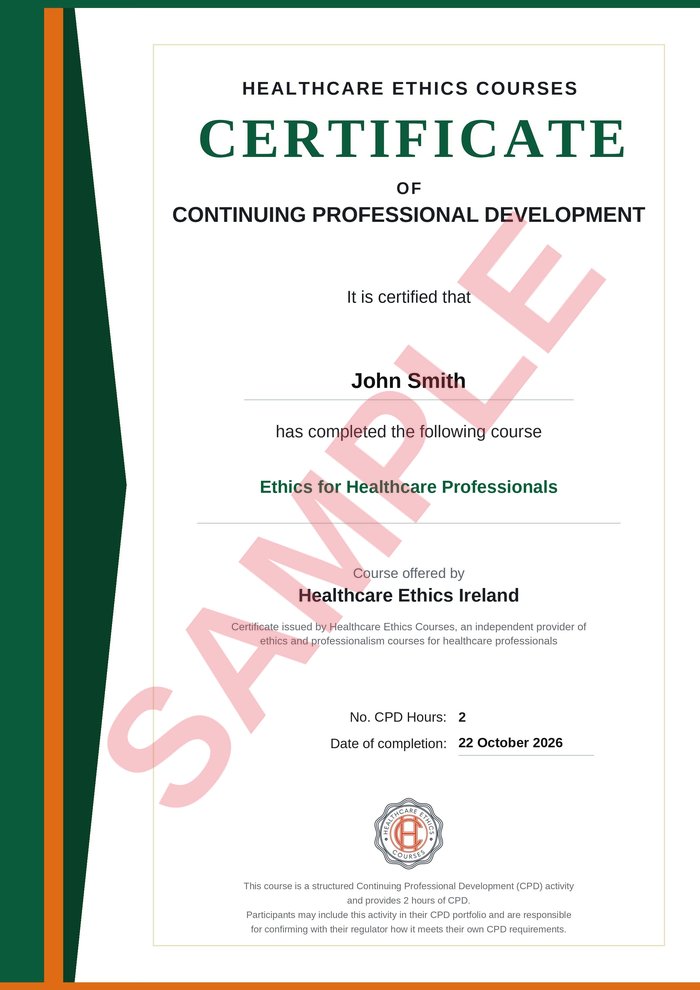
- Certificate issued by Healthcare Ethics Courses on completion, dated, with the course title and 2 CPD hours
- Price
- €100 · from €70 a course (Bulk Buy of 10)
Certificate issued by Healthcare Ethics CoursesRemediation courses for regulatory processes.
The certificate you will receive
How health and social care professionals use it
- With your written response to CORU or the Preliminary Proceedings Committee, alongside your own reflection
- In the content of an undertaking, or in your evidence to the Professional Conduct Committee or the Health Committee
- As a dated record of remediation when sanction is considered, or for an employer while your register is not yet open
Who this course is for
Facing an allegation of unethical behaviour or professional misconduct
The letter says a decision, a disclosure, a relationship or a way of working breached your registration board’s Code of Professional Conduct and Ethics. CORU defines professional misconduct as an act, omission or pattern of conduct that breaches the Code. This course is how you account for it — and show you have remediated.
Dealing with a CORU fitness to practise complaint
A patient, a service user, a colleague, an employer or a registration board has complained, and CORU has written to explain the nature of the complaint and who made it. Your written response is where your reasoning first appears; this course gives it a structure.
Before the Preliminary Proceedings Committee
The committee screens the complaint and decides whether it goes forward to a Committee of Inquiry. Insight shown in your response, with dated evidence attached, is on the file from the start.
Facing a Professional Conduct Committee or Health Committee inquiry
The complaint has gone to a Committee of Inquiry. Remediation completed before the hearing, dated and documented, is evidence you can put before the committee and before any decision on sanction.
Under an undertaking, conditions or a sanction
An undertaking you have agreed, conditions attached to your registration or a sanction may ask you to show what you have done to address the concern. The certificate is dated and records 2 CPD hours in ethics.
Facing a complaint while your profession is not yet regulated
A psychologist, a counsellor, a psychotherapist or another practitioner whose register is not yet open, facing a complaint through an employer or a service. CORU expects the first three psychologist registers to open in 2027. The questions a complaint raises are the same — what happened, what you understood, what has changed.
The concerns this course speaks to
Professional and ethical boundaries
Expensive gifts from a grateful patient, contact outside the professional relationship, a relationship with a colleague that went beyond a working one, a dual relationship. Keeping the boundary is the professional’s responsibility, with a patient or a colleague. Section 3 sets out the boundaries the Irish codes share — exploitation, dual relationships and conflicts of interest — and Section 7 compares a weak and a strong response to a physiotherapist who accepted gifts from a patient.
Probity and an allegation of dishonesty
A falsified or backdated record, an error concealed, a false claim, misleading communication. Probity, honesty and accountability have a section of their own (Section 6), and Section 7 compares responses to a documentation breach and to inflated insurance claims. Personal and professional conduct, including dishonesty, was a theme in 49% of the cases CORU concluded in 2022 to 2024.
Consent and a refusal of treatment
Treatment without informed consent, risks not explained, a refusal overridden. Section 2 covers autonomy and respect for patient choice, and Section 4 the dilemma between a patient’s refusal and acting in their best interest.
Confidentiality and privacy
A case discussed in a public place, records accessed without a reason, an online post that made a service user identifiable, a disclosure made, or not made, to protect someone else. Section 5 covers the ethical duty of confidentiality, data protection law (GDPR) and confidentiality in digital systems, and Section 4 the conflict between confidentiality and a duty to disclose.
Fees, commercial pressure and conflicts of interest
Treatment recommended for gain, a cheaper option not explained, a financial incentive or an interest not declared. The course covers commercial pressure and overtreatment against undertreatment as dilemmas (Section 4), financial integrity (Section 6) and financial misconduct as a case comparison (Section 7).
Online conduct, telehealth and social media
A post about a case, a message to a service user, a video consultation overheard by others. Section 5 covers digital professionalism and social media, and telehealth and virtual consultations; Section 4 treats digital professionalism as a dilemma of its own.
Communication and respect
A dismissive reply to a concern, a remark that left a patient or a service user feeling disrespected. Section 7 compares a weak and a strong response to disrespectful communication. Communication was a theme in 39% of the cases CORU concluded in 2022 to 2024.
When two obligations conflict
A patient’s choice against your clinical judgement; confidentiality against someone else’s safety; welfare against commercial or organisational pressure; a scarce resource between two people. Section 2 shows how the four principles are balanced, and Section 4 works through six dilemmas of Irish practice.
Facing a CORU fitness to practise complaint or Professional Conduct Committee inquiry? This course helps you remediate — and show it.
Buy this course — €100 (€70 with Bulk Buy 10)What the course covers
Ten sections and 54 lessons, with a reflective quiz closing each of the first nine and a post-course assessment at the end.
Introduction — Why Ethics Matters in Irish Healthcare
Five lessons
Core Ethical Principles — Autonomy, Beneficence, Non-Maleficence, Justice
Five lessons
Regulator Codes of Conduct — Ethical Standards in Ireland
Six lessons
Common Ethical Dilemmas in Irish Healthcare Practice
Six lessons
Confidentiality, Data Protection, and Digital Professionalism
Six lessons
Probity, Honesty, and Accountability in Healthcare Practice
Six lessons
Weak vs Strong Ethical Responses — Case Comparisons
Six lessons
Demonstrating Ethics in Fitness-to-Practise and Remediation Processes
Six lessons
Embedding Ethics into Professional Identity and Resilience
Six lessons
Conclusion and Key Takeaways
Two lessons, Conclusion and Key Takeaways, and the post-course assessment
Show every lesson title
- Section 01 · Introduction — Why Ethics Matters in Irish Healthcare
- The Role of Ethics in Healthcare; Why Regulators Prioritise Ethics; Ethics as Part of Professional Identity; Consequences of Ethical Lapses; Why Ethics Matters Today.
- Section 02 · Core Ethical Principles — Autonomy, Beneficence, Non-Maleficence, Justice
- Autonomy — Respecting Patient Choice; Beneficence — Acting in the Patient’s Best Interest; Non-Maleficence — “Do No Harm”; Justice — Fairness and Equality in Care; Balancing Principles in Practice.
- Section 03 · Regulator Codes of Conduct — Ethical Standards in Ireland
- Medical Council of Ireland — Guide to Professional Conduct and Ethics; Nursing and Midwifery Board of Ireland (NMBI) — Code of Professional Conduct and Ethics; Pharmaceutical Society of Ireland (PSI) — Code of Conduct for Pharmacists; Dental Council of Ireland — Code of Practice regarding Professional Behaviour and Ethical Conduct; CORU — Code of Professional Conduct and Ethics; Shared Ethical Themes Across Regulators.
- Section 04 · Common Ethical Dilemmas in Irish Healthcare Practice
- Consent and Autonomy; Overtreatment vs Undertreatment; Confidentiality vs Duty to Disclose; Managing Commercial Pressure; Digital Professionalism and Social Media; Resource Allocation and Fairness.
- Section 05 · Confidentiality, Data Protection, and Digital Professionalism
- The Ethical Duty of Confidentiality; GDPR Compliance in Irish Healthcare; Confidentiality in Digital Systems; Digital Professionalism and Social Media; Telehealth and Virtual Consultations; Consequences of Breaches.
- Section 06 · Probity, Honesty, and Accountability in Healthcare Practice
- Probity as a Core Ethical Duty; Honesty in Documentation and Communication; Financial Integrity in Healthcare; Accountability in Clinical Practice; Consequences of Dishonesty or Lack of Accountability; Building a Culture of Probity and Accountability.
- Section 07 · Weak vs Strong Ethical Responses — Case Comparisons
- Clinical Error — Prescribing Mistake; Documentation Breach; Boundary Violation; Financial Misconduct; Disrespectful Communication; Key Lessons Across Cases.
- Section 08 · Demonstrating Ethics in Fitness-to-Practise and Remediation Processes
- Why Ethical Demonstration Matters; How Regulators Assess Ethical Behaviour; Weak vs Strong Demonstrations; Evidence That Reassures Regulators; Remediation Portfolios in Healthcare Practice; Long-Term Monitoring and Growth.
- Section 09 · Embedding Ethics into Professional Identity and Resilience
- Ethics as Professional Identity; Daily Ethical Habits; Reflection and Accountability as Ongoing Practice; Building Resilience to Uphold Ethics; Mentorship and Role Modelling; Sustaining Ethics Across a Career.
- Section 10 · Conclusion and Key Takeaways
- Conclusion; Key Takeaways.
How to respond to a CORU fitness to practise complaint or inquiry
Whether it goes to the Preliminary Proceedings Committee or a Committee of Inquiry, a written response to an ethics complaint has to show your reasoning. These are the four parts to set out, and what the course gives you for each.
Nobody reading your response can know what you were thinking at the time; they can only read what you write now.
- The standard engagedWhich principles and which part of your Code the situation engaged — autonomy, benefit, avoiding harm, fairness, honesty, confidentiality.Section 2 sets out the four principles, and Section 3 the codes of the five Irish regulators, CORU among them, and the themes they share.
- The conflictWhere two obligations conflicted, stated plainly.Section 4 works through six dilemmas of Irish practice, from consent and autonomy to commercial pressure and resource allocation.
- The decision and its reasonWhich obligation you put first, and why, with what you knew at the time.Section 7 sets weak and strong responses side by side in five cases.
- The reconsiderationWhat you would weigh differently now, with dated evidence of what has changed.Section 8 covers the evidence of remediation and the remediation portfolio — and this course is a dated item for it.
An acknowledgement that continues with but reads as a defence, not as insight.
Take advice from your indemnifier, your union or professional body, or a solicitor before you respond to anyone.
Facing a CORU fitness to practise complaint or Professional Conduct Committee inquiry? This course helps you remediate — and show it.
Buy this course — €100 (€70 with Bulk Buy 10)How this course helps with a CORU complaint
What separates a weak response from a strong one
The course pairs weak and strong responses to five situations — a prescribing mistake, a record added later without saying so, gifts from a patient, inflated insurance claims and a dismissive reply to a patient — and shows what separates them: an honest admission, an explicit reference to the standard, targeted CPD, and evidence that can be checked, such as audits, reflective logs and mentor attestations. In one case in CORU’s trends report a committee found that “early admissions had demonstrated some limited insight”: admissions count, and so does what follows them.
Remediation you can evidence
Section 8 sets out what a remediation portfolio contains: reflective essays, CPD certificates, audit results, mentor or supervisor attestations, and patient or colleague feedback. CORU’s own framing is the one to write to: “Every complaint represents an opportunity for learning and reflection”. For the stages from the first letter to the High Court, see the fitness to practise process in Ireland, explained.
Read the primary sources
- Health and Social Care Professionals Act 2005, section 52 — complaints and the grounds of complaint
- CORU — Codes of Professional Conduct and Ethics, one for each registration board
- CORU — what happens when CORU receives a complaint
- CORU — fitness to practise information for registrants
- CORU — Fitness to Practise Trends Report 2022–2024
- Health and Social Care Professionals Act 2005, section 66 — sanctions
Who wrote it

Dr Shehzad Iqbal
Course author and facilitator, Healthcare Ethics Ireland
Dr Iqbal wrote this course. He combines clinical practice with a formal postgraduate qualification in healthcare law and ethics, and has worked with registrants across the regulated health professions, online and face to face, since 2020.
He founded Probity & Ethics in the United Kingdom in 2020 and Healthcare Ethics Courses, which issues the certificates, in 2025. More about us.
MBBS · MRCS · MRCGP · Postgraduate Certificate in Healthcare Law and Ethics, University of Dundee
Written and reviewed by Dr Shehzad Iqbal. Last reviewed .
In short
Ethics for Healthcare Professionals is a two-hour, self-paced remediation course for health and social care professionals in Ireland who face a CORU fitness to practise complaint, a Preliminary Proceedings Committee decision or a Professional Conduct Committee or Health Committee inquiry — and for psychologists, counsellors, psychotherapists and others whose registers are not yet open. It covers the four principles — autonomy, beneficence, non-maleficence and justice; the codes of the five Irish regulators, CORU among them, and the themes they share; six dilemmas of Irish practice in which obligations conflict; confidentiality, data protection (GDPR), digital professionalism and telehealth; probity, honesty and accountability; five weak and strong responses compared; and the reflection, insight and remediation a response to a regulator needs. Ten sections, the first nine closing with a reflective quiz, a post-course assessment, and a dated certificate from Healthcare Ethics Courses. It is remediation and dated evidence of it; it decides no complaint, and it is not a substitute for advice from your indemnifier, your union or professional body, or a solicitor.
When two principles conflict
An ethics complaint need not describe a professional who ignored ethics. It can describe one who followed one principle and did not see that another was engaged. Respect for a person’s choice, acting for their benefit, avoiding harm and fairness can all point the same way. The appointment that leads to a complaint can be the one in which they did not, and the question afterwards is whether the professional saw the conflict and decided it, or simply acted.
The course sets out each principle, the standards the Irish codes share and the risks when each is breached, and applies them to digital systems, social media and telehealth as well as the clinic, the ward and the community. Where principles conflict, it shows how to balance them, explain the decision and document the reasoning.
In a written response, name the principles that were in conflict, say which you put first and why, and say what you would weigh differently now.
What these words mean
Three terms behind a CORU complaint, and the principles the course is built on.
- Professional misconduct
- A ground of complaint in section 52(1) of the Health and Social Care Professionals Act 2005. CORU defines it as any act, omission or pattern of conduct that breaches your registration board’s Code of Professional Conduct and Ethics. The course treats dishonesty as misconduct even where no one was harmed.
- Fitness to practise
- The term all five Irish regulators use for their complaints and inquiry processes. At CORU a fitness to practise complaint is screened by the Preliminary Proceedings Committee and may go to an inquiry.
- Remediation
- The steps taken to correct a lapse, with evidence that they happened. Section 8 sets out the evidence and the remediation portfolio: reflective essays, CPD certificates, audit results, mentor or supervisor attestations, and feedback.
The four principles and the other terms the course uses
- Autonomy
- A person’s right to make informed decisions about their own care, including refusing treatment. In practice: consent that is informed, voluntary and documented. Breached by paternalism, by pressure, and by a refusal that is not respected.
- Beneficence
- The obligation to act for the person’s welfare: safe, evidence-based care and speaking up for what they need. Breached by overtreatment, by undertreatment, and by putting convenience before welfare.
- Non-maleficence
- The obligation not to cause avoidable harm: safe prescribing, infection control and acting on clinical warning signs. Breached by errors, unsafe delegation and checks not made.
- Justice
- Fairness between people: care without discrimination or bias, and fair allocation when there is not enough of something. Breached by preferential treatment and by unfair allocation.
- Informed consent
- Agreement to care given by a person who has been told what they need to know to decide, and who is free to decline. A consent complaint asks whether each of these was present and whether the record shows it.
- Confidentiality
- The duty to keep information about a patient or service user private unless they consent or the law requires disclosure. The course covers data protection law (GDPR) and confidentiality in digital systems.
- Probity
- Acting with fairness, integrity and transparency in clinical, administrative and financial matters: honest records, honest claims and honest communication with patients, colleagues and the regulator.
- Dual relationship
- A second relationship with a patient, a service user or a colleague alongside the professional one — a friendship, a business arrangement, a romantic or sexual relationship. Keeping the boundary is the professional’s responsibility.
- Open disclosure
- Openness with a patient or service user after a patient safety incident. The Patient Safety (Notifiable Incidents and Open Disclosure) Act 2023 commenced on 26 September 2024, apart from section 68 (S.I. 482/2024), and CORU says that for a notifiable incident open disclosure must happen within 24 to 48 hours.
The standards and provisions a CORU complaint engages
A complaint about a CORU registrant is made and decided under the Health and Social Care Professionals Act 2005 and measured against the Code of Professional Conduct and Ethics that your registration board has made. These are the codes, the grounds, the committees that hear a complaint and the sections of the Act behind the sanctions.
Codes of Professional Conduct and Ethics — one for each registration board
Each registration board has made a Code of Professional Conduct and Ethics for its profession, such as the PRB Code for Physiotherapists and the SWRB Code for Social Workers. The codes are dated between 25 June 2019 and 24 March 2021 (the Podiatrists’ Code), and CORU says “All registrants must abide by a statutory Code of Professional Conduct and Ethics”. Read it.
For this course: Section 3 sets out the codes of the five Irish regulators, CORU among them, and the themes they share — probity, respect, accountability, boundaries and digital professionalism — so that a response can name the standard engaged.
Section 52 — the grounds of complaint
A complaint may be made to the Council by or on behalf of any person or by a registration board. The grounds in section 52(1) are professional misconduct, poor professional performance, a relevant medical disability, failure to comply with a condition, an undertaking or a consent, a prohibition or restriction on practice elsewhere, a contravention of the Act, rules or bye-laws, and a conviction for an offence triable on indictment. CORU defines professional misconduct as an act, omission or pattern of conduct that breaches the Code. Read it.
For this course: The conduct an ethics complaint describes — consent, confidentiality, a boundary, honesty — is the subject of Sections 2 to 7.
The Preliminary Proceedings Committee and the Committees of Inquiry
The Preliminary Proceedings Committee screens out complaints that are trivial or vexatious, without substance or made in bad faith. The Professional Conduct Committee deals with complaints about a registrant’s conduct or competence; the Health Committee inquires into whether a registrant’s health is affecting their ability to practise. A Committee of Inquiry is two registrants and one non-registrant. Mediation is possible only if both parties consent. Read it.
For this course: Section 8 covers what a strong demonstration of ethics contains, and the evidence and portfolio you can put before the PPC or a Committee of Inquiry.
Sections 66 and 68 — sanctions and High Court confirmation
Since 1 January 2021 the sanctions in section 66(1) are admonishment or censure, conditions, suspension, cancellation of registration and a prohibition on applying for restoration; there is no fine. Since 24 March 2021, under section 68, the heavier sanctions do not take effect unless the High Court confirms the direction; an admonishment or censure takes effect on confirmation or once the 30-day appeal window passes. Read it.
For this course: Insight and remediation are weighed before a sanction is decided, and the course is dated evidence of remediation completed before that decision.
Also engaged: Section 52(1)(e) — failure to comply with an undertaking is itself a ground of complaint · Patient Safety (Notifiable Incidents and Open Disclosure) Act 2023 — commenced on 26 September 2024, apart from section 68 (S.I. 482/2024); CORU applies it to public and private health services and their staff · Psychologists, counsellors and psychotherapists — registers not yet open; CORU expects the first three psychologist registers to open in 2027.
What happens after a complaint reaches CORU
The stages of a CORU fitness to practise complaint, from the letter to the High Court. At each of them three questions are worth answering in writing: did you see the problem, do you understand its effect, and what has changed, with dated evidence.
The complaint reaches CORU
A complaint may be made by or on behalf of any person or by a registration board, on the grounds in section 52(1). CORU writes to explain the nature of the complaint and who the complainant is (CORU, information for registrants). It publishes no fixed response time: take the date from your letter, or ask CORU.
The Preliminary Proceedings Committee
The Preliminary Proceedings Committee screens the complaint first. It screens out complaints that are trivial or vexatious, without substance or made in bad faith, and decides whether the rest go forward to a Committee of Inquiry. Mediation is possible only if both parties consent. Your written response to the PPC is the first place insight appears on the file.
Undertakings
In CORU’s words, “Undertakings are agreed commitments by the registrant to address identified concerns” (trends report). In the cases concluded in 2022 to 2024 they were the largest Committee of Inquiry outcome: 13, against 7 censures. Failing to comply with an undertaking is itself a ground of complaint under section 52(1)(e).
The inquiry — Professional Conduct Committee or Health Committee
A Committee of Inquiry is two registrants and one non-registrant. The Professional Conduct Committee deals with conduct or competence, and CORU says its hearings are normally held in public; the Health Committee deals with health, and CORU says its hearings are normally held in private. You may bring a legal or other representative at your own expense (CORU).
The sanction and the High Court
The sanctions in section 66(1) run from admonishment or censure to conditions, suspension, cancellation and a prohibition on applying for restoration. CORU then applies to the High Court to confirm the direction; under section 68 an admonishment or censure takes effect on confirmation or once the 30-day appeal window passes. In the 151 cases concluded in 2022 to 2024 the Committee of Inquiry outcomes were undertakings 13, censure 7, conditions 4, suspension 4, cancellation 4 and admonishment 3.
If your register is not yet open
CORU says the first three psychologist registers are now expected to open in 2027, and the registers for counsellors and psychotherapists are not yet open. Until then there is no CORU fitness to practise process for these professions; a complaint can still reach you through an employer, and the same three questions apply.
Facing a CORU fitness to practise complaint or Professional Conduct Committee inquiry? This course helps you remediate — and show it.
Buy this course — €100 (€70 with Bulk Buy 10)Registered with another Irish regulator? Each has its own Act and its own process — courses for doctors, nurses and midwives, dentists and pharmacists, or every course →
Frequently asked questions
What should a response to a CORU complaint about ethics contain?
Your reasoning: which principles were engaged, where they conflicted, which you put first and why, what the effect was, and what you would weigh differently now. Name the standard in your registration board’s Code of Professional Conduct and Ethics that the conduct did not meet before CORU names it, and attach dated evidence of what has changed. Have your indemnifier, your union or professional body, or a solicitor read it before it is sent.
Should I take advice before I respond to CORU?
Yes — before anything is written to CORU, the Preliminary Proceedings Committee or your employer, speak to your indemnifier, your union or professional body, or a solicitor. If you work in a public health service, the Clinical Indemnity Scheme says it does not provide representation at disciplinary proceedings or before professional regulatory bodies. Nothing on this page is legal advice.
Can this course be used as evidence of remediation in a CORU complaint?
It can be part of the evidence, but no course decides a complaint. In CORU’s trends report one committee took account of a demonstration of insight together with references and testimonials, and another found that early admissions showed some limited insight. This course gives you a dated certificate and the material for a reflection that names the standard. Check the wording of any undertaking or condition with your adviser before you rely on a course.
I am a psychologist, a counsellor or a psychotherapist. Is this course for me?
Yes. CORU says the first three psychologist registers are now expected to open in 2027, and the registers for counsellors and psychotherapists are not yet open, so there is no CORU fitness to practise process for you today; ask CORU about the timetable for your register. A complaint can still reach you through an employer or a service, and the questions it raises are the same: what happened, what you understood, and what has changed.
Which code does the course cover?
Section 3 sets out the standards of the five Irish regulators — the Medical Council, NMBI, the Pharmaceutical Society of Ireland, the Dental Council and CORU — and the themes they share. CORU registrants are measured against the Code of Professional Conduct and Ethics their own registration board has made; read yours alongside the course and name it in your response.
When can I share information about a patient or service user without consent?
The course sets out the ethical duty of confidentiality and the disclosures it treats as permitted — with consent, where the law requires it, and to prevent serious and imminent harm (Section 5) — and the conflict between confidentiality and a duty to disclose (Section 4). Before you disclose, or if a complaint says you should not have, take advice: whether a disclosure was justified depends on the facts and on the law.
How is this course different from Professionalism for Healthcare Professionals?
This course is about the reasoning behind a decision: the principles involved, the conflicts between them, and how you account for them. The Professionalism course is about conduct and behaviour: the core attributes of professionalism, lapses and their consequences, and communication, documentation and digital practice. A complaint that says a decision was wrong fits this course; one that describes how you behaved fits the Professionalism course; some complaints need both.
Does the course cover social media and telehealth?
Yes. Section 4 treats digital professionalism and social media as a dilemma, and Section 5 covers confidentiality in digital systems, digital professionalism and social media, and telehealth and virtual consultations.
CORU has proposed an undertaking. Can this course be part of my response?
It can be part of the evidence. CORU describes undertakings as agreed commitments by the registrant to address identified concerns, and in the cases concluded in 2022 to 2024 they were the largest Committee of Inquiry outcome. Whether a course meets a particular undertaking or condition depends on its wording, so read it with your adviser, and ask CORU, before you enrol.
How long does it take, and does it count towards my CORU CPD?
The course is 2 CPD hours, self-paced, with access for twelve months from purchase. The certificate is issued on completion, dated, with the course title and the CPD hours. CORU requires 30 CPD credits in every 12-month period, counts one hour of new or enhanced learning as one credit, audits records, and says the key element is reflecting on how an activity will change your practice; whether a course counts towards your credits is for CORU to say.
Can I get a certificate with a later date?
No. The certificate records the date you completed the course, and that date does not change. If CORU, a Committee of Inquiry or an employer asks for recent evidence, you buy the course again: half price within twelve months of your original purchase, the full €100 after that.
Will anyone be told that I am taking the course?
No. Nobody is told you are enrolled. We do not share participant details with CORU, a registration board, an employer, a union or an indemnifier; the certificate reaches them only if you attach it to your own response.
Courses that work alongside this one
A complaint can raise more than one issue. These are the courses that pair with this one.
Professionalism for Healthcare Professionals
For a CORU complaint about conduct: the core attributes of professionalism, lapses and their consequences, and professionalism in communication, documentation and digital practice.
Ethical Boundaries with Patients and Colleagues
Boundaries with patients (emotional, sexual, financial, digital) and with colleagues (hierarchy, respect, bullying, conflicts of interest), the warning signs of boundary drift, and weak and strong responses.
Confidentiality in Healthcare Practice
What confidentiality means, everyday risks, information sharing and consent, team-based care, digital records, and breaches and complaints.
Probity and Honesty for Healthcare Professionals
Probity defined, dishonesty and clinical error compared, probity in documentation, billing and communication, and weak and strong responses to a probity concern.
Insight for Fitness to Practise
Weak and strong demonstrations of insight, why a lack of insight raises concern, and how to evidence insight in a portfolio and at a hearing.
Reflection for Fitness to Practise
Weak and strong reflective statements, the Gibbs, Rolfe and Johns models, reflection against apology and justification, and reflective portfolios.
Fitness to Practise for Healthcare Professionals
Fitness to practise across the five Irish regulators, weak and strong responses to concerns, portfolios of evidence, and professionalism at a hearing.
Ethics for Healthcare Professionals
This course. Autonomy, beneficence, non-maleficence and justice, the dilemmas in which they conflict, and the evidence of insight and remediation a response needs.
See all remediation courses for CORU and professions not yet regulated →
Start today, finish at your own pace
Immediate access on purchase. Twelve months' access, a dated certificate on completion, and 2 CPD hours issued by Healthcare Ethics Courses.